

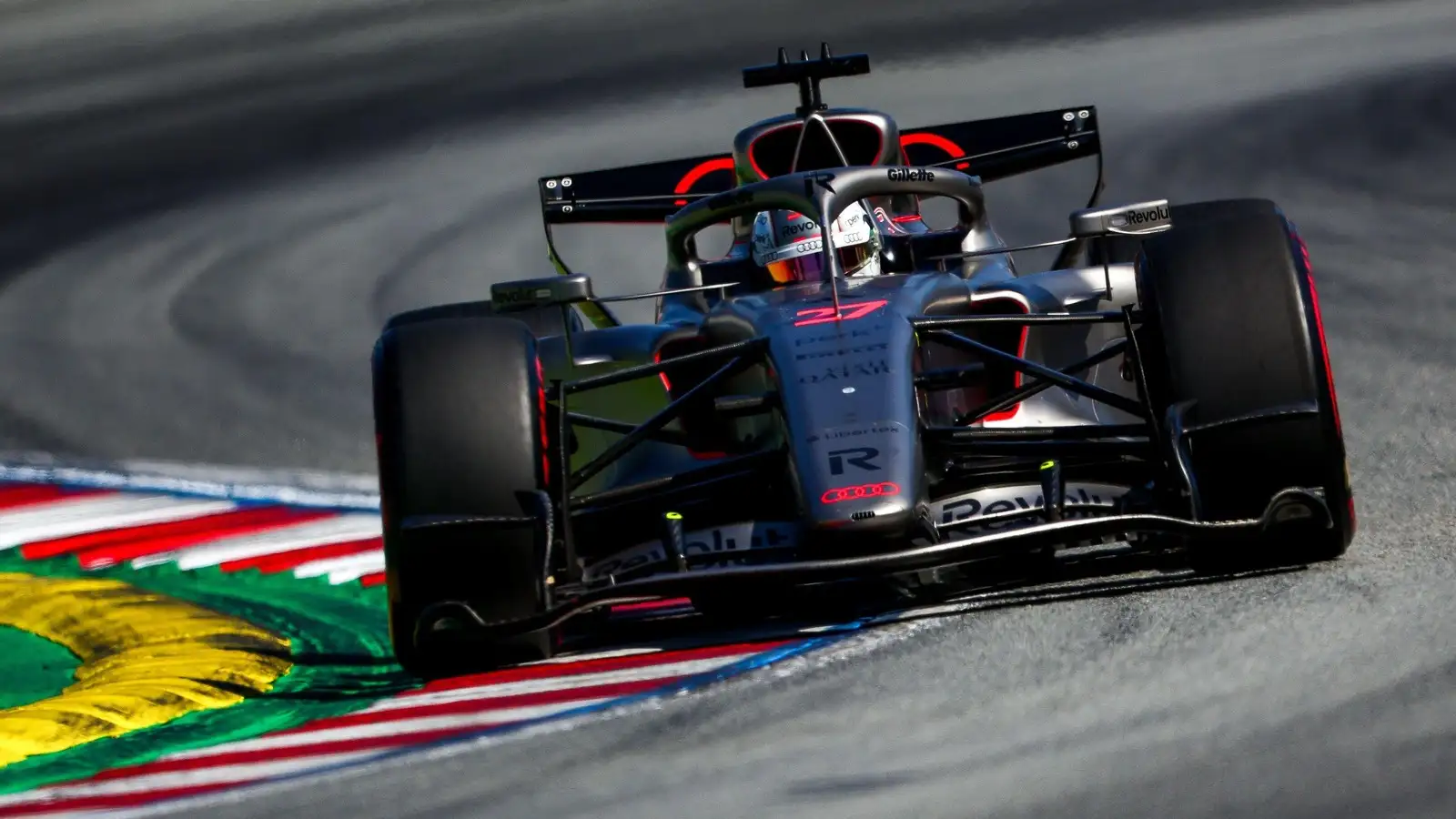
The Audi F1 team may be allowed to upgrade its power unit again in the F1 2026 season, but the German manufacturer won’t be doing so.
Under the Additional Development and Upgrade Opportunities [ADUO] system, Audi was awarded two upgrade ‘tokens’ at the first checkpoint after the Monaco Grand Prix, only one of which has been used.
Allan McNish explains why Audi will delay its next power unit upgrade
Want more PlanetF1.com coverage? Add us as a preferred source on Google for news you can trust
Rounding off the first half of the F1 2026 season with three consecutive points finishes, the Audi team has started to unlock potential from its R26 after the early stages of the season suggested pace and potential within the package.
Audi has been transparent that its biggest deficit has been on the power unit side of the equation, with the first offering from Neuberg proving largely solid and reliable, but lagging behind the benchmark offerings from Mercedes and Red Bull Powertrains.
While the drivers have highlighted the competitiveness of the chassis, Mattia Binotto has suggested the power unit accounts for about a second of Audi’s deficit to the front.
This evaluation was borne out in the FIA’s assessment of the power units under the ADUO benchmarking system, with Audi and Honda being the only power unit manufacturers [PUMs] to be granted the full two upgrade opportunities.
Evaluated on the internal combustion engine [ICE] alone, the ADUO system grants lagging PUMs additional upgrades and development time based on how far off the benchmark ICE a given unit is.
With Audi being given two, this indicates the ICE is at least four per cent down on performance compared to the benchmark RBPT engine.
Audi was clearly aware of this deficit as, following the first measurement window after the Monaco Grand Prix, the manufacturer cashed in one of its two opportunities via a PU upgrade at the Barcelona Grand Prix.
This update largely focused on driveability, rather than outright performance, with the drivers having struggled with this aspect of the engine in the first quarter of the season, mostly borne out by difficulties in getting the car off the line.
But the second permitted ADUO upgrade won’t be cashed in before the end of 2026, Allan McNish has revealed.
“It’ll be next year,” McNish said, following the Hungarian Grand Prix, when asked when the next PU update might come.
With Audi taking a measured approach to establishing a stable baseline of performance and organically growing in resources and knowledge as a team, McNish said a major consideration to introducing more upgrades comes down to managing budgets within the financial regulations – PUMs are also restricted by a budget cap, as well as the teams themselves.
“Everybody has got this trade-off between when you’re bringing upgrades, chassis and PU, and also where you spend your money,” McNish said.
“Because you can’t spend everything at one time, because then you don’t have anything to fight with later.
“So it’s got to be a managed expectation – and not just over one season, but multiple seasons as well.
“So, certainly from our point of view with the ADUO, we brought something in Barcelona straight away, which was some small adaptation, and that worked well, that helped us on our way.
“And then, I would say, the bigger parts are for 2027. So we will not see anything big on the power unit until then.”
More on Audi in F1
Audi half-season review: Should midfield rivals start to fear the German giant?
Audi F1 driver delivers verdict on rare £500k supercar after track test
With the power unit driveability improving by way of the Barcelona update, a performance-related upgrade will thus have to wait until 2027, but the Scot laughed when asked about how big a step the next change to the power unit might introduce.
“That’s 2027, give us a break! We’re only halfway through ’26; I need my cup of tea first!” he said.
“You’ve got where you’re going, but it’s also relative to the competition. So, therefore, we’re always benchmarking against the competition, and how quickly they move, and how quickly we can evolve.
“You could see that we’ve evolved in our performance this year so far, which has been definitely power-unit-related as well, making sure that we try to maximise some of the systems on that, but also definitely on the chassis with the upgrades that we spoke about there. And so, I think, we’ve definitely done that.
“We will do again in the second half of the year, but, for the power unit, that’s a ‘27 topic. It’s more hardware than anything, and that’s not a quick thing to change.”
With F1 going into a mandatory two-week summer break, McNish reflected on how the team recently ‘broke its duck’ after seven consecutive races of promise, but no points, with Silverstone marking the first of a trio of races in which Gabriel Bortoleto and Nico Hulkenberg have scored points.
“We had the [aero] upgrade in Austria, and that helped us a lot, especially in the lower-speed corners, where we were a little bit weaker,” he said.
“We’ve also adapted and been able to, I would say, help the drivability. Again, a lower speed corner type of thing.
“So, in these situations, it’s that. And then to try to extract, you find direction with the car, what it likes, what the driver likes, and that’s where we’ve just expanded a little bit.”
With McNish representing a replacement for the departed team principal Jonathan Wheatley earlier this year, the former F1 driver and highly successful sportscar driver’s first management role in Formula 1 has seen him join Mattia Binotto in the operation of the Audi team.
It’s only been a few short months, both for McNish and the Audi project, but the Scot says he sees plenty of reasons to be optimistic about the direction the team is travelling.
“Since I got directly involved, I can see growth in the people. You know, the confidence in the people. I think we’re functioning as a team, and [Budapest] was quite a difficult race because of different things,” he said.
“But the way that we executed it, I thought, was good. In terms of car performance, I think we’re better in qualifying than I expected. I didn’t think we would be quite so quick and consistently quick, and we are able to deal with that. We need to make a step forward again there.
“In terms of things that we are not so happy about, things we need to improve, we need to work on the starts. That’s something that again hurt us, dropping behind [Liam] Lawson because, at the end, there we had the opportunity to be ahead of one of the Racing Bulls, but we were beaten by both of them.
“But overall, I come away from it thinking, ‘Yeah, we’ve got a lot we can improve, a lot, and a lot we have to improve’.
“But we’ve now just jumped Williams in the Constructors’ Championship. We’ve consistently had Q3s. We’ve consistently had top tens in the races and points, and I can see with the development that we’re making as a team, operationally and also technically, that, actually, we’ll just get stronger.
“I suppose that’s the biggest thing that I feel is comfort, more than confidence: comfort that we are just getting stronger on an upward trend at the moment. But, being totally honest, where we are is in the midfield, and the gap to the top four teams is big.
“But considering we’ve done 11 races in our Formula 1 career, then I think it’s actually quite a good position to be in.”
Want to be the first to know exclusive information from the F1 paddock? Join our broadcast channel on WhatsApp to get the scoop on the latest developments from our team of accredited journalists.
You can also subscribe to the PlanetF1 YouTube channel for exclusive features, hear from our paddock journalists with stories from the heart of Formula 1 and much more!
Read next: ‘Clusterf**k’ – Ferrari insider finally lifts lid on famous Kimi Raikkonen pit stop blunder
Originally published by Planet F1 —
Read Original Article