

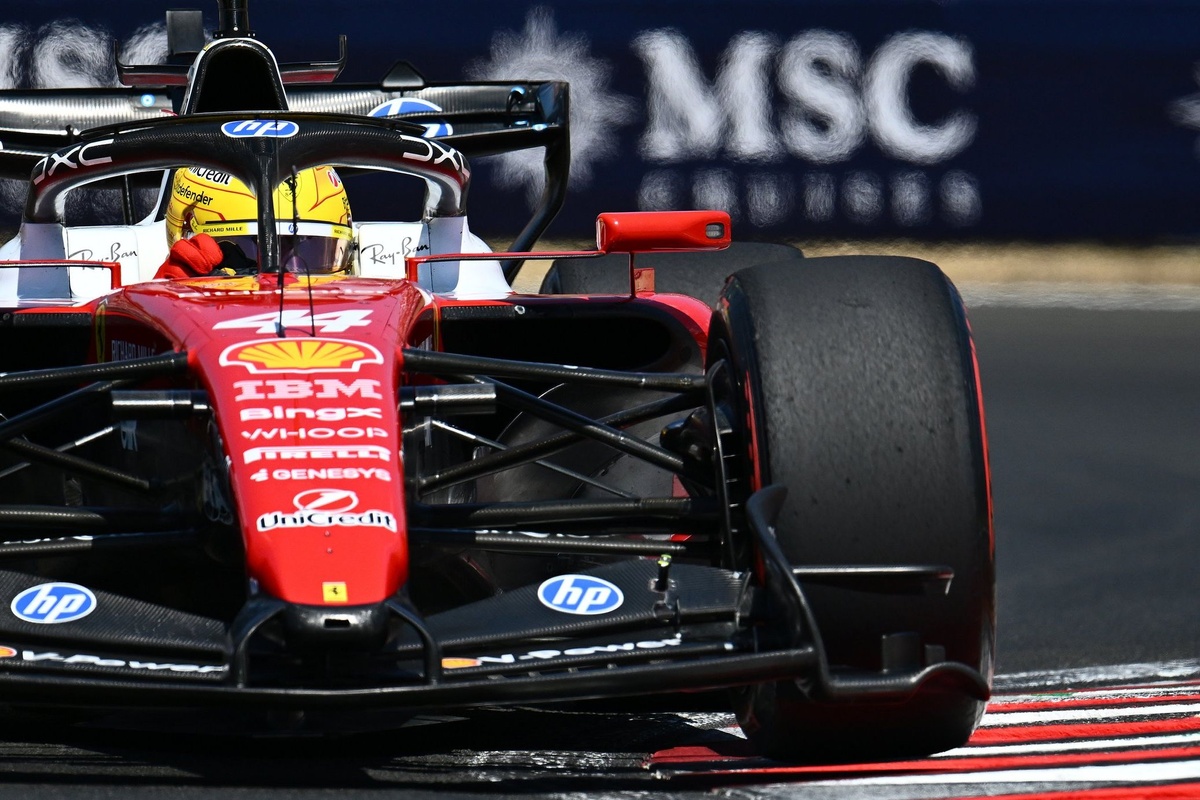
Rivals claim Ferrari has the most agile chassis in Formula 1, if not the best engine or aerodynamics, so its SF-26 is generally expected to shine at circuits where straightline speed is less valuable than an ability to carry high speeds into slow corners.
And yet neither Lewis Hamilton nor Charles Leclerc were able to claim pole position in Hungary. More remarkable still, and contrary to expectations, neither made it onto the podium come Sunday.
Leclerc was fastest in FP1 on Friday before Hamilton led him in a 1-2 in FP2. But in FP3 and qualifying, both were trumped by ultimate race winner Lando Norris. Hamilton came closest in qualifying and the race, falling just 0.012s short of pole position – but he was then penalised three places for impeding Oscar Piastri on the McLaren driver’s second flying lap.
On Sunday Hamilton started P5 on soft tyres, but didn’t get a good enough start to clear Max Verstappen’s Red Bull, which compromised his race. Having undercut past Verstappen late on, he was instructed to pit under a late virtual safety car, which cost him track position to both Verstappen and Mercedes’ Kimi Antonelli, and the scrubbed soft tyres fitted at that stop weren’t enough to enable him to pass either car.
A 5s penalty for speeding in the pitlane then dropped him from fourth to fifth, behind Leclerc, at the flag.
Leclerc, having qualified two tenths off Hamilton, said “the pace was never to the level of Lewis” in that session. He started the race from second on the grid – on soft tyres, like his team-mate – but dropped behind Piastri, Verstappen and Hamilton on the opening lap and struggled to make an impact throughout.

Charles Leclerc, Ferrari, Lewis Hamilton, Ferrari
Photo by: Dom Gibbons / Formula 1 via Getty Images
McLaren team boss Andrea Stella claimed Norris “overachieved” in qualifying on pole, and said McLaren’s chassis wasn’t yet the equal of Ferrari’s. So how did the car that theoretically ought to have been strongest around the Hungaroring, given track position, fail to reach the podium?
“I think the thing that is standing out for me is that, out of the last three races, there were two races where we were expecting to struggle and we finished first and second,” said Leclerc afterwards.
“And in the race where we expected to do well, we finished fourth and fifth. So, there's clearly a tendency – and it's not that one car is doing well because he [Lewis] is doing exceptionally in the car.
“I mean, both cars seem to have that tendency of being good in the weekend where we expected to struggle and struggling in the weekend where we thought we would be good. So, this has to be understood.
“It's also true that with a good start today, things could have looked very different. Because on a track like this, there's not much overtaking.”
There are definitely failures of execution, as team boss Frederic Vasseur pointed out in his post-race debrief. Neither Leclerc nor Hamilton had a new set of medium-compound Pirellis available for the race, having used them in qualifying, but neither were they very satisfied with the car’s behaviour on that compound during the weekend.
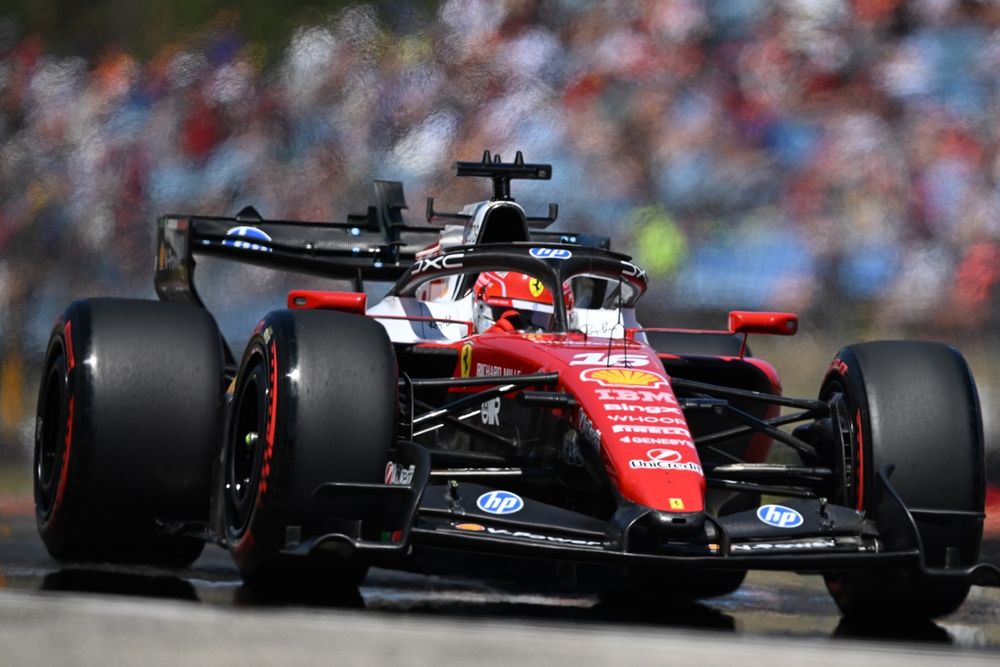
Charles Leclerc, Ferrari
Photo by: Artur Widak / NurPhoto via Getty Images
All the other frontrunners started on mediums. The SF-26 has a reputation for being hard on tyres, so it was to be expected that race pace might prove problematic when starting on a soft compound in ambients of 31C and a track temperature of 51C. But the softs, as flagged up by Pirelli as early as Friday, were holding up remarkably well – indeed, Verstappen drove the balance of the race on a set of scrubbed softs he fitted at the end of lap 41.
Also, despite this well-known vulnerability, McLaren was wary enough of the undercut threat to its drivers from Hamilton – while they were running 1-2 – that they pitted Piastri in response to the Briton’s first stop (for hards) at the end of lap 13. Hamilton successfully undercut Verstappen but came out behind Liam Lawson’s VCARB – then the Dutchman mugged him as he was passing Lawson.
By his own admission, Lewis “didn’t see Max coming”. And as he also conceded, “my race went downhill from there.”
The final pitstop cost him track position and was far from perfect: Hamilton locked up into the box and missed his marks, slowing the wheel change, then he released the pitlane speed limiter fractionally too early.
“I'm not really sure why we stopped at the end,” he said. “I got the call right before the pit lane entry, so I didn't have time to debate it. I would never have stopped if it meant that I was giving up track position.”
Vasseur framed it as a classic example of mistakes compounding with one another, and that is probably right. But Hamilton has won enough world championships to know how to execute a race weekend properly.


Questions still linger over the apparent capriciousness of the car itself. It is as if the SF-26 keeps taking the team and its drivers by surprise, whereas Mercedes and McLaren – despite the occasional technical failure – enjoy a level of predictability that enables them to be proactive, while Ferrari has to be reactive.
“We weren't particularly stellar at any point of the race,” concluded Leclerc.
“The first stint on hard [his second race stint] wasn't bad, the last stint on soft was pretty good. But then, there were too many ups and downs and I think that's really where we need to work.
“[The target] is try and find that consistency with this car, because it's just been very, very tricky on some stints for Lewis and some other stints with me. And it's just a little bit strange how uncorrelated everything is.”
We want your opinion!
What would you like to see on Motorsport.com?
- The Motorsport.com Team
Originally published by motorsport.com —
Read Original Article