

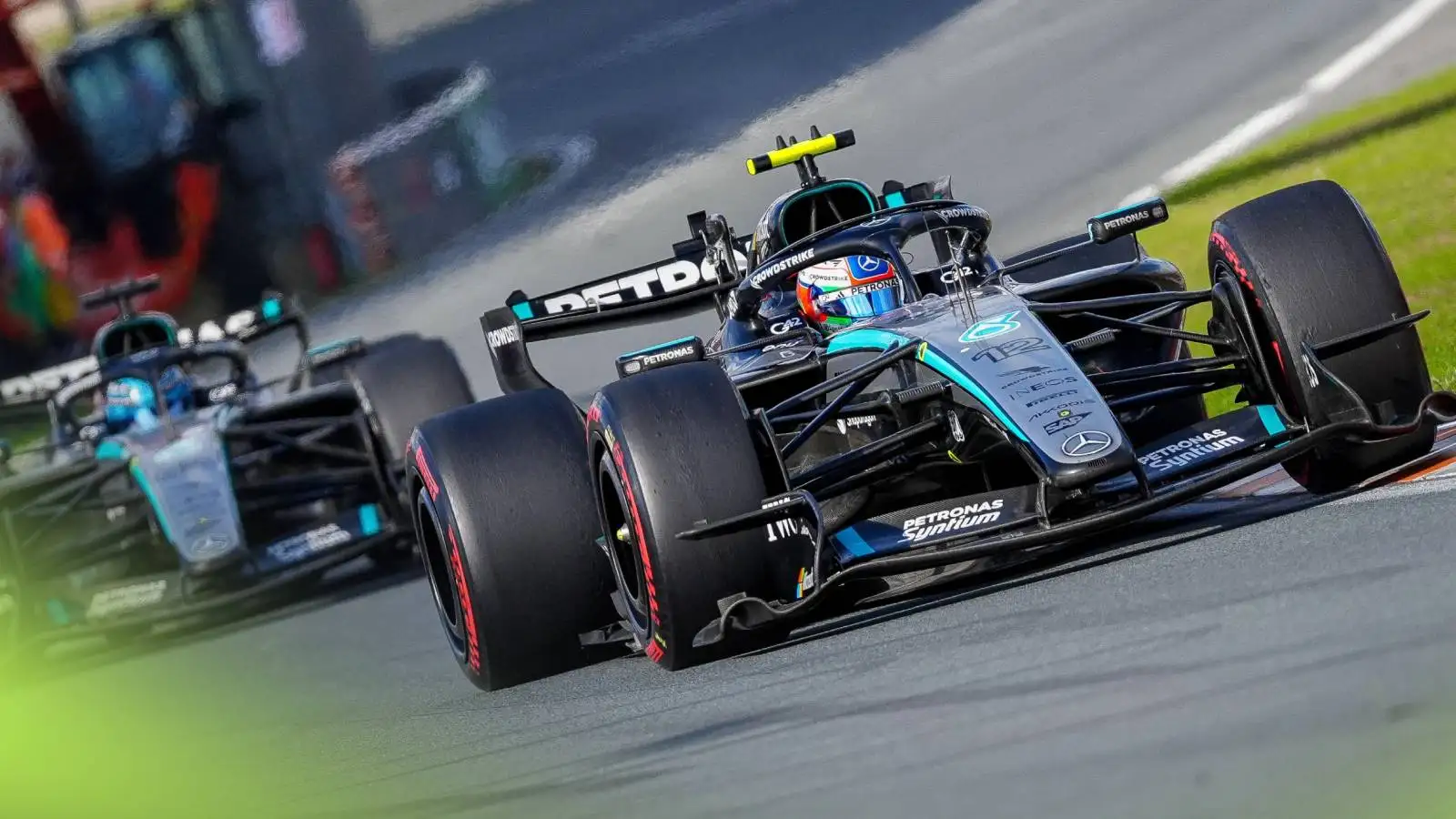
Mercedes has revealed its thinking behind the team order to George Russell to move aside for Kimi Antonelli in the closing stages of the Dutch Grand Prix.
With Antonelli having pitted for fresh tyres under the late virtual safety car, Mercedes instructed Russell to allow his teammate through into second place with six laps remaining.
Mercedes explains George Russell’s Dutch GP team order
With Antonelli having been clearly ahead of Russell in the grand prix, Mercedes choosing to bring him in and make use of a ‘free’ stop under the VSC meant he wound up behind his teammate but on considerably fresher tyres.
With Ferrari’s Lewis Hamilton stalking Russell, Mercedes opted against allowing an organic battle for position between its two drivers and, instead, just instructed Russell to let Antonelli, on much fresher tyres, go through back into second place.
This seemed to fly in the face of the messaging from the team, with team boss Toto Wolff having ruled out the use of team orders as both drivers remain in contention for the championship.
But there was logic to the instruction: allowing Russell to try fending off Antonelli would likely be completely fruitless, given the disparity in tyres, while it would only increase the risk to the team in terms of potential tension, a crash, or giving Hamilton the chance to get ahead of one, or both, drivers.
Certainly, while Russell initially questioned the call, there was no post-race tension regarding the instruction and, in its own post-race debrief, Mercedes has addressed where there was any concern over how the British driver would accept the team order.
“Because of the early red flag and the delayed schedule, we held the full debrief on Monday rather than immediately after the race,” deputy team principal Bradley Lord said on the Nu Silver Arrows radio show.
“George naturally questioned the instruction when he first received it, but he understood the wider picture.
“Kimi had taken the opportunity for a free stop under the virtual safety car. Had George made the same stop, he would have dropped behind a Ferrari and surrendered the podium position. We had also been very clear in the Sunday morning strategy meeting that the field was too close for our drivers to lose time fighting one another. That discussion provided the basis for the decision.
“Had the circumstances been reversed, we would have acted in exactly the same way. The priority was to give the car in second the best chance of attacking, while giving the car in third clear air and the best opportunity to defend its position.
With Norris more than 10 seconds up the road from Antonelli, the chances of catching the McLaren driver were remote and, in that scenario, the question was put to Lord and trackside engineering chief Andrew Shovlin whether Antonelli could have lingered in front of Russell to give his teammate the benefit of overtake mode, in order to help defend against Hamilton’s proximity as the seven-time F1 world champion was just a second behind Russell’s W17.
“We discussed it,” Shovlin said.
“The gain was around two tenths of a second, principally on the straight, which was also where George was most vulnerable. There was a concern that trying something we had not rehearsed could cause the cars to become entangled.
“Because the lap-time gain was not enormous, we decided it was better for Kimi to move ahead cleanly and give George clear air for the best possible exit and braking performance. With these cars, you cannot follow at a two-tenths gap. Ferrari’s best chance was to gain momentum from the final corner or attack very late under braking.
“George’s defence was extremely impressive. You might not have given him even a 50 per cent chance of keeping both Ferraris behind. The virtual safety car helped cool the situation for a lap or two and allowed him to manage his energy, but he executed the defence superbly.”
With overtake mode being made available through energy management, Lord said the difference between the aid and its predecessor, DRS, in how they operate made it an easier decision to make.
“DRS was a more predictable tool for this type of tactic,” he said.
“Energy deployment is less predictable, and Zandvoort was also easier to overtake at than Singapore was in the race where that DRS tactic became famous.”
With Russell having returned to form at Zandvoort, winning the sprint race before a competitive showing in the grand prix, the British driver’s difficult phase from before the summer break appears to have ended.
With technical issues having plagued his side of the garage, resulting in Russell admitting to driving with less confidence than usual, Shovlin confirmed the power unit issues that had compromised several weekends have now been resolved.
“It took some investigation, but we understood the issue and resolved it before Budapest, where he had a stronger weekend,” Shovlin said.
“At Zandvoort, he won the Sprint and qualified very well throughout the event. We hope he can carry that form into the next phase of the championship.”
Want to be the first to know exclusive information from the F1 paddock? Join our broadcast channel on WhatsApp to get the scoop on the latest developments from our team of accredited journalists.
You can also subscribe to the PlanetF1 YouTube channel for exclusive features, hear from our paddock journalists with stories from the heart of Formula 1 and much more!
Read next: Mercedes left ‘head-scratching’ after Zandvoort exposes unexpected weakness
Originally published by Planet F1 —
Read Original Article