

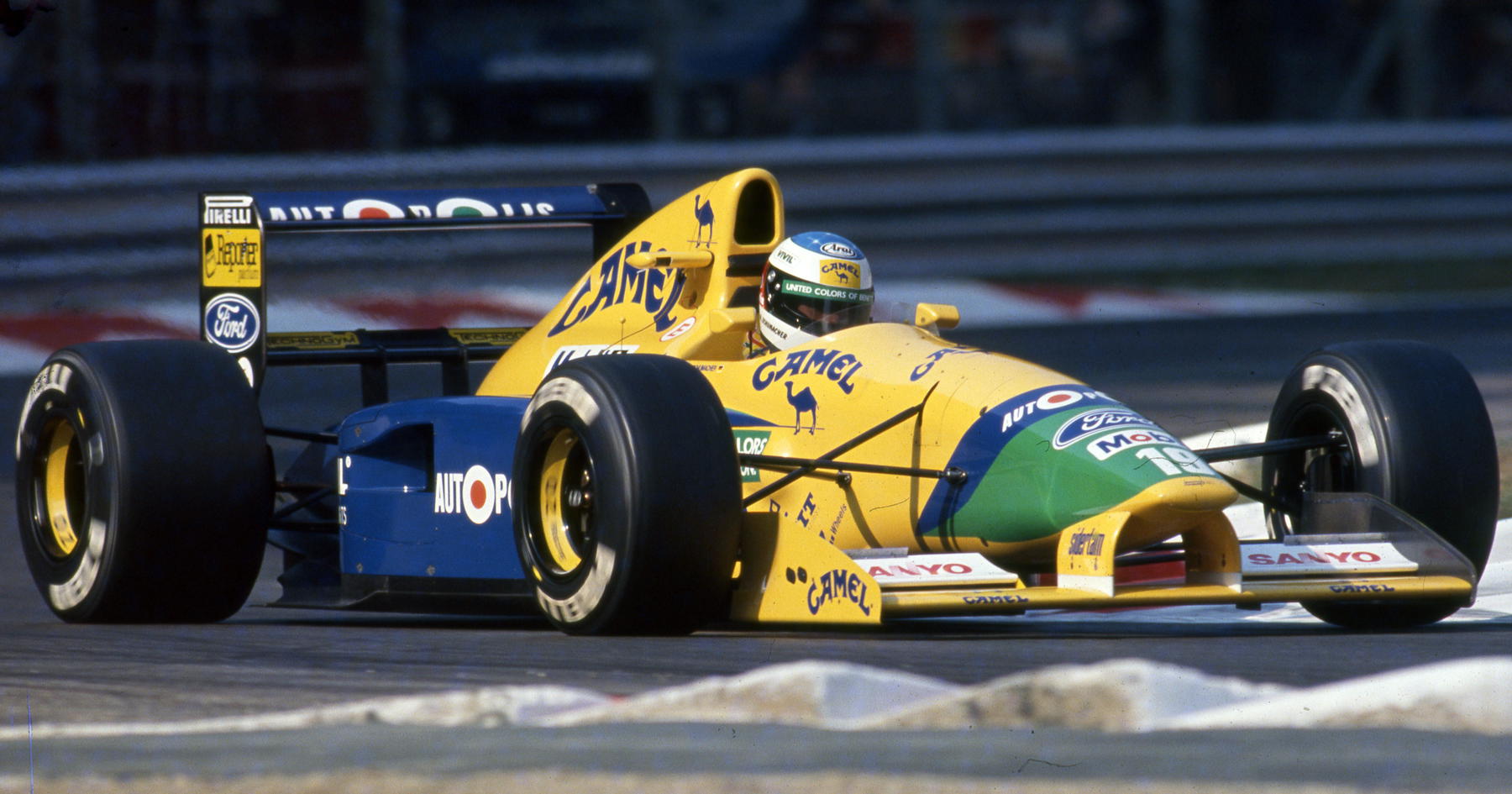
Michael Schumacher drove one race for Jordan in 1991, and the entire battle for his signature ultimately came down to a single word.
In the letter of intent the German signed before his debut at Spa-Francorchamps, his management had secretly changed “the contract” to “a contract.”
It was a small difference on paper, a big difference in practice. Schumacher thereby promised to sign a contract at some point, but not necessarily a racing contract with Jordan Grand Prix.
From a sporting perspective, that single race was already more than just a showcase.
Schumacher qualified impressively in seventh place but came to a stop in the race due to clutch problems. Still, that one lap was fast enough to shake up the paddock.
Benetton team boss Flavio Briatore saw his chance, pounced on it immediately after that weekend, and skillfully exploited the loophole in the preliminary agreement.
This was possible because, in 1991, F1 had no authority whatsoever to monitor dual driver contracts. Whoever had the smartest lawyer, the fattest wallet, or simply the most influence in the paddock came out on top.
Eddie Jordan went to an Italian court to block the move, but was rebuffed: a letter of intent with such a loosely worded clause was no match for a team that put a real contract on the table.
The decision wasn’t made in a courtroom, but in the Monza paddock, with Bernie Ecclestone mediating between Briatore and Jordan. The matter was settled through a game of musical chairs, not by a judge.
Domino effect at Monza
There was a problem for Benetton, however, as it didn’t have an open seat. To make room for Schumacher, Briatore sidelined Roberto Moreno - the very man who had finished fourth at Spa.
Moreno was not amused and threatened to take the matter to court himself. He was bought off with a sum that, according to insiders, ranged from five to nearly six hundred thousand dollars, and then moved on to the seat Schumacher had vacated at Jordan. Exactly what was agreed upon between Benetton, Jordan, and Moreno never fully came to light.
Thus, Jordan got an experienced driver as a consolation prize, Moreno got money and a seat, and Benetton simply got the greatest talent of his generation. Only the debt Eddie Jordan had outstanding with Schumacher himself remained unpaid.
That matter wasn’t fully settled until April 1997, when Schumacher reportedly transferred about one million dollars. By then, Jordan had long since ceased to be an underdog or a rookie, and Schumacher had become a two-time world champion.
Jordan never minced words about how heated emotions ran at the time: he acknowledged the friction and the annoyance, and that he had taken the matter to an Italian court.
Briatore described it as a battle on multiple fronts at once, with Jordan on one side and Tom Walkinshaw representing Benetton on the other. Both team bosses were later able to laugh it off, which is of course easier when you were on the winning side.
The aftershocks of this whole affair are greater than the anecdotal story itself. The chaos surrounding Schumacher and Moreno was, in fact, the direct catalyst for the establishment of the FIA Contract Recognition Board in 1992.
Since then, every F1 driver’s contract must be registered in Geneva, where the CRB decides which contract takes precedence. As a result, lengthy legal disputes between teams have largely disappeared from the sport; FIA President Mohammed Ben Sulayem still referred to it in the conflict surrounding Oscar Piastri in 2022 as the mechanism for resolving this kind of issue.
There’s also another side to this story. Even with a CRB in place, Schumacher likely wouldn’t have stayed long with a team that was fifth in the constructors’ championship at the time, with 13 points compared to Benetton’s 33.
The main difference lies in the speed: without that loophole in the letter of intent, the move would have taken months or even an entire season, rather than just one weekend.
For Jordan, it remained a bitter pill to swallow that his team had discovered the talent, let him make his debut, and ultimately gained nothing from it except a recently fired driver and, six years later, a settlement.
Originally published by RacingNews365 —
Read Original Article