

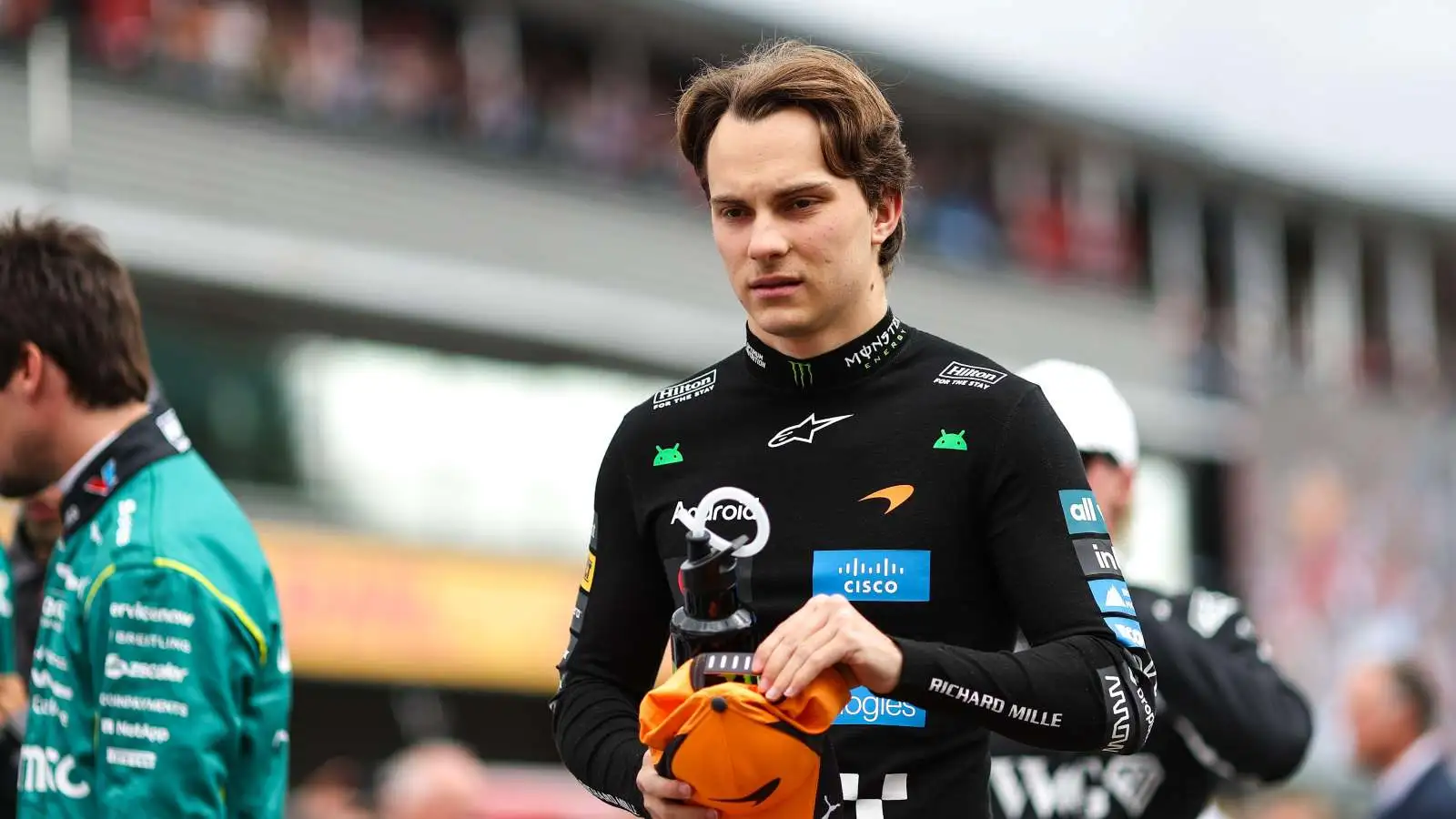
Oscar Piastri bluntly admitted the new regulation set is not up to his expectations, with the influence of battery power proving “a pretty crap way of going racing.”
The near-equal split in internal combustion and electrical power has led to vocal criticism on the grid, but the increased complexity of going racing has brought further issues for the drivers to navigate.
Oscar Piastri gives rare blunt assessment in F1 2026 verdict
Want more PlanetF1.com coverage? Add us as a preferred source on Google to your favourites list for news you can trust.
The current power units deploy in certain areas of a circuit which may be beyond the driver’s control, with a self-learning element prompting the power unit to deploy some power where it believes is the most efficient place on the circuit to do so, to look to maximise lap time.
Some teams have struggled to perfect the new systems, with customer teams such as McLaren looking to play catch-up with their factory counterparts in better understanding their power units.
Piastri was one of several drivers to voice concerns around a lack of straight-line speed at Spa, and the Australian was forthright in his views on the subject.
“It sucks. I can’t really say it any other way than that,” Piastri told PlanetF1.com and others in Belgium.
“I certainly wouldn’t have been the only person [to complain]. I know George [Russell] has had a lot of issues with that this weekend and maybe the last couple of weekends, and speaking to some others, it’s a similar story.
“When you’ve got qualifying grids decided by computers behaving or misbehaving, it’s a pretty crap way of going racing.
“So, here is obviously going to exaggerate it a lot and make it worse, but when you come in from a qualifying session, you look at all the corners and go, ‘I’m on par with my teammate, and I’m two tenths behind at the end of it’, it’s not a very nice feeling.
“It’s not just happening with the HPP [Mercedes High Performance Powertrains, ed.] teams, I think it’s happening with other engine manufacturers as well, so it’s not an us-specific problem.
“But, the engines are so complicated. They are sensitive to everything, and even things you do on an out-lap can dictate what happens, so it’s it’s a very tricky way of going racing.”
How the Belgian Grand Prix unfolded
Antonelli wins Belgian Grand Prix as Hamilton penalised over Russell DNF
Belgian Grand Prix results: Antonelli wins, Russell DNF disaster
Drivers are already looking towards next season and beyond for potential improvements in the behind-the-wheel experience, where planned changes would push the power units back towards a larger majority in internal combustion power.
While there will be a rough 58-42 split in 2027, alongside an increase in fuel flow rate, that will adjust to 60-40 in 2028, with the fuel flow rate set to increase further.
Piastri, though, is not so hopeful.
“The change in fuel flow and the less deployment are not going to fix those specific issues, it’s to do with how the engine’s calibrated, how the engine learns,” he explained.
“It’s kind of ingrained into these engines. Obviously, it will get better as all the manufacturers understand the engines more, and it’s not just a problem for us or Mercedes, it’s a problem with all the engines, speaking to some of the other drivers – but the fact that it’s even a problem is pretty annoying for more than just myself.”
Additional reporting by Thomas Maher
Want to be the first to know exclusive information from the F1 paddock? Join our broadcast channel on WhatsApp to get the scoop on the latest developments from our team of accredited journalists.
You can also subscribe to the PlanetF1 YouTube channel for exclusive features, hear from our paddock journalists with stories from the heart of Formula 1 and much more!
Read next: George Russell ‘numb’ after Lewis Hamilton collision as Mercedes issue sparks anger
Originally published by Planet F1 —
Read Original Article