

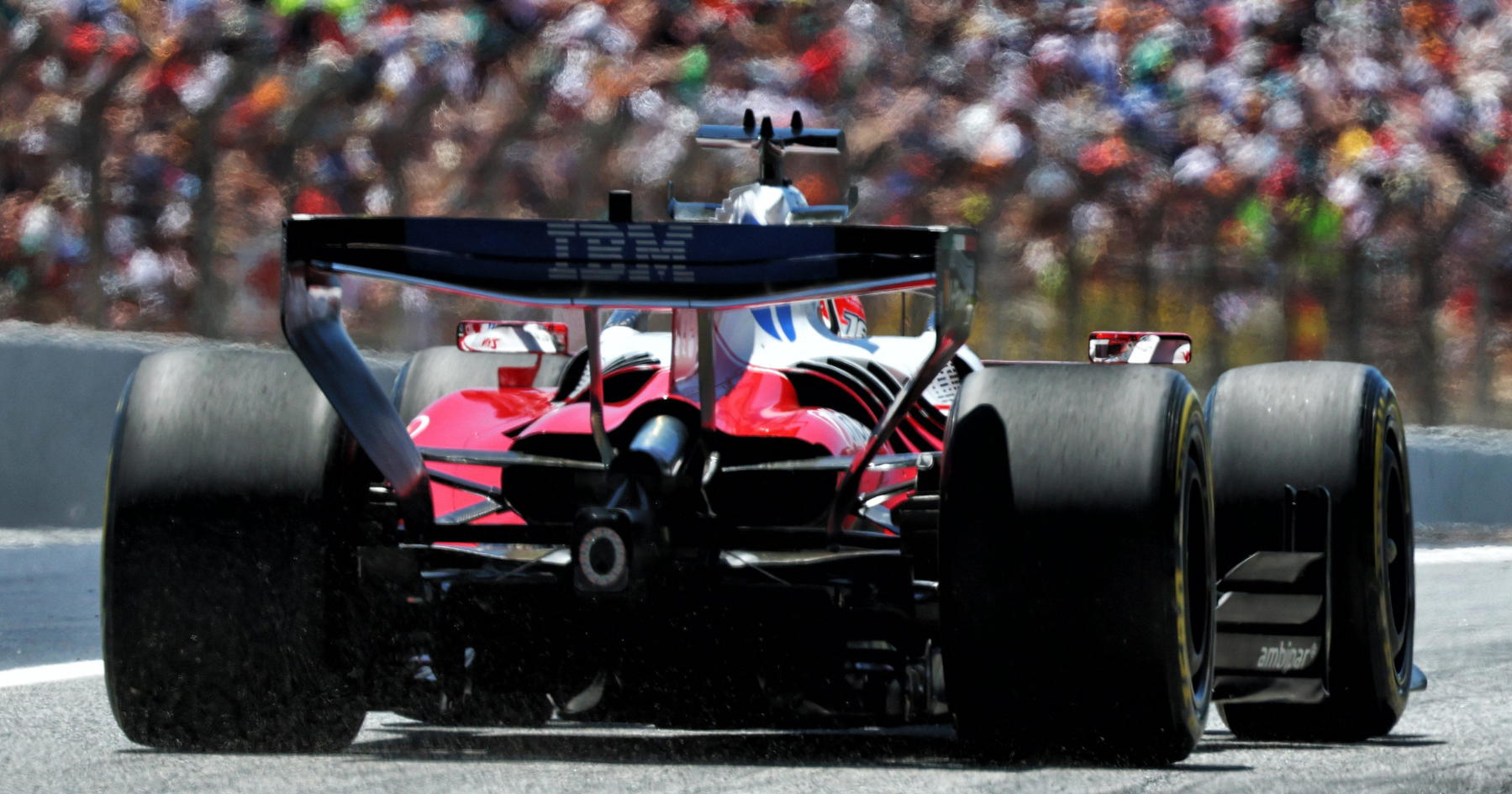
Ferrari will look to continue its momentum this weekend with the introduction of an engine upgrade at the Austrian Grand Prix. RacingNews365 technical expert Paolo Filisetti dives into what is new with the engine.

Ferrari will field its third power unit of the season in Austria, equipped with the first ADUO upgrade in a bid to catch up to the benchmark, which has been deemed to be Red Bull.
The choice to bring the evolved power unit to Austria has strategic relevance, both linked to circuit layout in Spielberg and the run of four grand prix events in five weeks.
The team received a boost last time out in Spain as Lewis Hamilton climbed to the top step of the podium, thanks in part to the aerodynamic developments brought to the event.
Ferrari is seeking to recover the ground lost in the early races as quickly as possible as it looks to inject itself into the title fight, and has thus far been lacking when it comes to its PU.
A key feature of the Ferrari internal combustion engine is steel cylinder heads, a choice that has prompted discussion among insiders due to the significantly higher weight compared to the aluminium alloys that are common among rival power units.
The root of Ferrari's choice is steel's ability to withstand very high temperatures, having a significantly lower coefficient of expansion compared to aluminium.
This characteristic is extremely functional to the basic choice of the project, namely that of a "hot" power unit, where the intake air also reaches temperatures above 100 degrees.
This choice, which effectively reduces the density of the incoming air, thus theoretically reducing the oxygen available for triggering combustion, instead has a very favourable effect in terms of better combustion of the mixture.
What this means is that, inside the combustion chamber, with higher intake air temperatures, better atomization of the mixture is achieved, which in this way instantly increases the flame front, thereby increasing the power generated.
In practice, while the fuel flow rate established by the regulations remains unchanged and is controlled by means of the FIA flow meters, the result is that, for the same potential energy — that is, the same fuel volume — a higher energy balance is achieved, meaning greater power output.
As far as the evolution of the PU introduced in Austria is concerned, this involves an increase in the intake temperature to between 114°C and 116°C, alongside the adoption of a new fuel specification.
Its fuel partner, Shell, has developed a fuel made up of a different molecular chain compared to the one used up to the previous race, specifically designed to increase the flame front following the variation in intake air temperature.
Essentially, the new formula, according to some reports, would allow an improvement in thermal efficiency of around 2–3%. This means lower consumption, which can be interpreted in two ways.
With the same amount of fuel carried and burned, it delivers greater power, for the reasons explained previously; or, on circuits where power is less relevant, it allows a lower quantity of fuel to be carried, thereby helping to reduce the car’s weight when running with a full fuel tank.
This could further lend itself to Ferrari's advantage in the initial phase of the race, where even a minimal upper hand becomes crucial for the strategy that follows.
At Ferrari, there is confidence that the evolution of the PU can reduce the gap compared to those built at Mercedes, who has won six out of the opening seven races.
A rumour coming from Mercedes is that the Brixworth technicians have identified what triggered the recent battery failures within the PU, and are studying definitive countermeasures to the problem, linked to a sudden increase in the temperature of some battery elements.
However, the solution cannot be immediately implemented, so its temporary fix revolves around less extreme energy charging and deployment routines compared to those used up to Barcelona.
But as a consequence, this results in slightly lower performance and could bring others, including Ferrari, into play.
Also interesting:
Join RacingNews365's Nick Golding and Samuel Coop as they look ahead to this weekend's Austrian Grand Prix! The discuss if Lewis Hamilton can continue his fine form after entering the title fight and the importance of Red Bull having a strong event at home.
Rather watch the podcast? Then click here!


Get the latest F1 news from RacingNews365 directly in your Google feed! Click on the link below and you’ll see your favourite F1 website appearing even more often. That way, you’ll never miss any news, analyses, interviews, or exclusives.
Follow RacingNews365 on GoogleMost read
Never miss a thing from the Formula 1 season! Add the 2026 F1 schedule to your calendar at the touch of a button. Subscribe below and put the dates and times of every race directly on your PC or smartphone, so you don't miss a second from the new season.
Download the F1 calendar Download the F1 calendar-
Tech
Revealed: The secrets behind Ferrari's latest weapon to beat Mercedes -
FIA declare Austrian GP heat warning as scorching temperatures loom
-
Interview
Formula E addresses Jeddah situation after Gen4 season opener confirmation -
Pierre Gasly finally receives Monaco GP trophy after long wait
-
Max Verstappen voices excitement over major Red Bull introduction
-
Lando Norris demoted and Lewis Hamilton boosted in updated F1 ranking
-
Why Max Verstappen could decide two drivers' F1 fates
-
2026 F1 Austrian Grand Prix - start time
-
Max Verstappen talks with Red Bull continue as Ferrari confirm power unit upgrade – RacingNews365 Review
-
Liam Lawson hits back at Red Bull exit reason: 'I won't accept that'
Originally published by RacingNews365 —
Read Original Article