

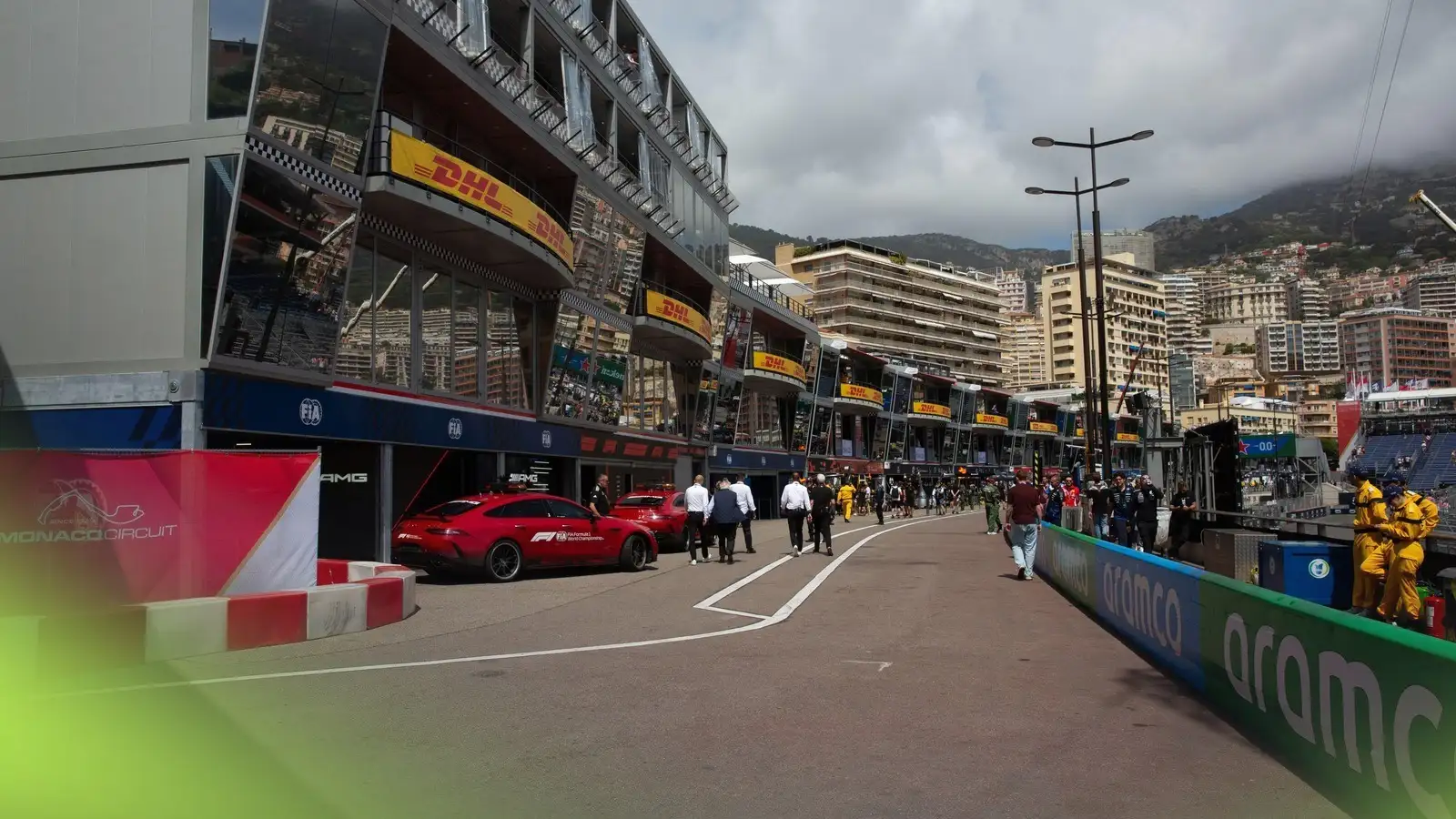
Rescinding Pierre Gasly’s post-race Monaco GP penalty, restoring him to the podium, has opened a Pandora’s Box for Formula 1 and the FIA.
Gasly was penalised for pit lane speeding, only for Alpine to prove the timing system was flawed.
The precedent of disparity
Want more PlanetF1.com coverage? Add us as a preferred source on Google for news you can trust.
The post-race fallout goes far beyond Alpine. Gasly was not alone; a host of other drivers were flagged by the same system, plunging the validity of the speeding penalties meted out during the race into doubt.
The definitive factor for Gasly was timing.
His infractions occurred when it made strategic sense for Alpine to leave him on track and absorb a post-race time addition.
Crucially, this delay preserved Alpine’s right to appeal, a legal avenue slammed shut for Oscar Piastri, Lewis Hamilton, and George Russell, who all served their time penalties mid-race.
The 77-centimetre variance
At the heart of the crisis is a single pit lane timing loop.
Every circuit on the F1 calendar divides its pit lane into micro-segments anchored by electronic loops at fixed distances, allowing for a simple calculation of average speed.
The breakdown in Monaco was not caused by a hardware overhaul; the loops were identical to the previous season.
Changes to the placement of two barriers opened up the pit entry and allowed drivers to take a straighter line, shortening the trajectory between the loops by 77 centimetres.
For any car traversing the entry on the absolute limit of the speed restrictor, this variance triggered a false positive.
This is a quirk unique to Monaco’s curved pit entry.
On circuits where pit lanes run straight and timing loops sit perfectly parallel, such geometrical errors are mathematically impossible.
But in the principality, where the loops are angled along a curve, verifying the exact minimum distance between tracking points is paramount.
The Monaco crisis was born from a basic failure to measure the track.
A systemic silence
What remains unexplained is whether a fresh measurement was ever taken ahead of the grand prix weekend, or if race officials simply assumed the track footprint was unchanged.
The teams identified the anomaly as early as Friday practice and flagged it, and Formula One Management (FOM) has since admitted it was aware of the issue.
Yet on Sunday, F1 entered its premier event with stewards completely blind to the problem.
When the issue flared up during the grand prix, race control relayed a clear message to the stewards: they were unaware of any systemic fault.
This exposes the deeper institutional failure: a catastrophic breakdown in communication.
The barrier adjustments should have been accounted for.
Whether it was the FIA’s duty to audit the barrier placement or FOM’s responsibility to recalibrate the timing loops, the sport blew past multiple opportunities to intercept the error before Sunday.
Even if the hardware could not be adjusted mid-weekend, the anomaly could have been formally communicated and a remedy found.
More on the Monaco GP penalty controversy
Monaco GP fallout escalates as McLaren launches FIA appeal
Pierre Gasly hits back at rivals over Monaco podium appeal row
Separation of church and state
Instead, the fallout has exposed the fragile architecture connecting the FIA and FOM.
As the sport’s regulator and commercial rights holder respectively, the two entities operate under fundamentally clashing mandates.
FOM answers to a commercial directive to maximise entertainment value, fan engagement, and the return on Liberty Media’s multi-billion-dollar investment.
The FIA, conversely, exists to protect sporting purity and regulatory compliance.
While they frequently align, their structural disconnect creates massive friction, and this institutional encroachment cuts both ways.
The bitter standoff surrounding the Andretti Global grid entry is a prime example: the FIA held sole regulatory authority to approve the expansion, while FOM leveraged commercial roadblocks until the United States Department of Justice intervened.
Conversely, the FIA has overstepped its bounds into the commercial sphere.
A prominent example occurred when FIA President Mohammed Ben Sulayem publicly labeled a rumored twenty-billion-dollar Saudi valuation of the sport as an “inflated price tag,” cautioning potential buyers to apply common sense.
The public meddling into the value of a publicly traded entity infuriated FOM, drawing an explosive legal warning from Liberty Media which accused the regulator of unacceptably interfering with its exclusive commercial rights.
This ongoing institutional Cold War demonstrates the deep-seated tension built into F1’s dual-headed governance structure.
While FOM continuously pushes the boundaries of its commercial influence to control the sporting narrative, the FIA leadership has shown an equal willingness to stray across the regulatory line to exert leverage over the sport’s commercial realities.
This exact boundary is something the European Commission has historically guarded with immense scrutiny, and its preservation is precisely why the sport’s 100-year agreement and the Concorde Agreement exist.
The modern grey area is the Formula 1 Commission, a collaborative stakeholder forum designed to insulate the sport from erratic changes.
While the FIA World Motor Sport Council retains the formal power to approve or reject rule changes, its power is somewhat ceremonial and it typically rubber stamps regulations pre-debated and decided within the F1 Commission.
This tripartite governance is an accepted habit, not a legal requirement.
It is a covenant written into commercial contracts, but it cannot override the foundational fact that the FIA remains the sovereign regulator of the sport.
That FOM operates and owns the data infrastructure used to police the competitors on timing is a relationship that demands urgent interrogation.
FOM possesses the specialised technical expertise to run these timing feeds, but the arrangement allows a commercial entity to control the evidence used in judicial officiating.
Under the current Concorde governance agreement, FOM holds the exclusive right to supply timing data, a right it promptly monetises by selling trackside branding to luxury partners like TAG Heuer.
A constitutional crisis
On the Wednesday following the Monaco race, FOM acknowledged the data glitch and provided Alpine with the evidence required to meet the strict “significant, new, and relevant” threshold for an FIA Right of Review.
But by correcting a technical wrong, the sport has unwittingly engineered a far more dangerous constitutional crisis.
The teams and drivers penalised in-race are left entirely without recourse.
Their track position was surrendered, their race strategies ruined, and their time spent in the pit box cannot be refunded.
While Mercedes, McLaren, and Red Bull are fully justified in questioning the fairness of the Gasly reversal, the initial false positives had one saving grace: they were applied consistently.
By rescinding the Monaco GP penalty for a single competitor, because his team was able to appeal when its rivals could not, the stewards introduced a profound inequality that violates the FIA’s International Sporting Code (ISC).
The code explicitly binds the governing body to exercise its powers in a “fair and equitable manner.” In Monaco, equity vanished.
Alpine escaped the trap because of a post-race technicality, while its rivals were permanently penalised.
In fixing a tracking error, the stewards introduced a constitutional infraction.
The International Court of Appeal (ICA) addressed this exact paradox during a 2023 GT Open round at the Red Bull Ring, where an erroneous safety car procedure threw the field into chaos.
The ICA explicitly ruled that when a race director’s mistake causes “irreparable damage” to competitors, the principle of “sporting fairness” anchored under Article 1.1.1 of the ISC must remain absolute.
The court decreed that sporting fairness is the cornerstone of any action taken by the FIA or its judicial organs.
That mandate extends directly to the stewards, the body empowered to ensure the application of the regulations as written.
Stewards are not FIA staff, nor are they representatives in a corporate sense; they function as an independent panel, acting as the judge on matters where race control typically acts as the prosecutor.
Drawn from a small pool of international officials who usually hold senior positions within local sporting authorities, they are deeply familiar with the vagaries of motorsport and the F1 rulebook.
However, their power is strictly bound by the regulations as they are written, severely limiting their ultimate discretion and agency.
Once FOM’s error was revealed and Alpine had satisfied the rigid requirements of the Right of Review, the stewards were forced down a narrow judicial course of action that created an unavoidable sporting paradox.
By wiping away Gasly’s penalties, the stewards effectively sustained an unfair sporting disadvantage for all of those who served pit lane speeding penalties in the race, and those who lost position following the Frenchman’s reinstatement.
More significant is the potential financial repercussions, with teams earning tens of millions of dollars in prize money from FOM based on their constructors’ championship finishing position.
The decision of the stewards, born out of an FOM blunder, has created a legal quagmire leading to an unforeseen impact far greater than an individual result, and one that will take months to fully play out.
It is critical that officiating systems are infallible, else it undermines the sporting integrity of the competition.
A technical oversight by FOM, worsened by an operational silence, has created a regulatory mess that the FIA has no legal vocabulary to clean up.
Want to be the first to know exclusive information from the F1 paddock? Join our broadcast channel on WhatsApp to get the scoop on the latest developments from our team of accredited journalists.
You can also subscribe to the PlanetF1 YouTube channel for exclusive features, hear from our paddock journalists with stories from the heart of Formula 1 and much more!
Originally published by Planet F1 —
Read Original Article