

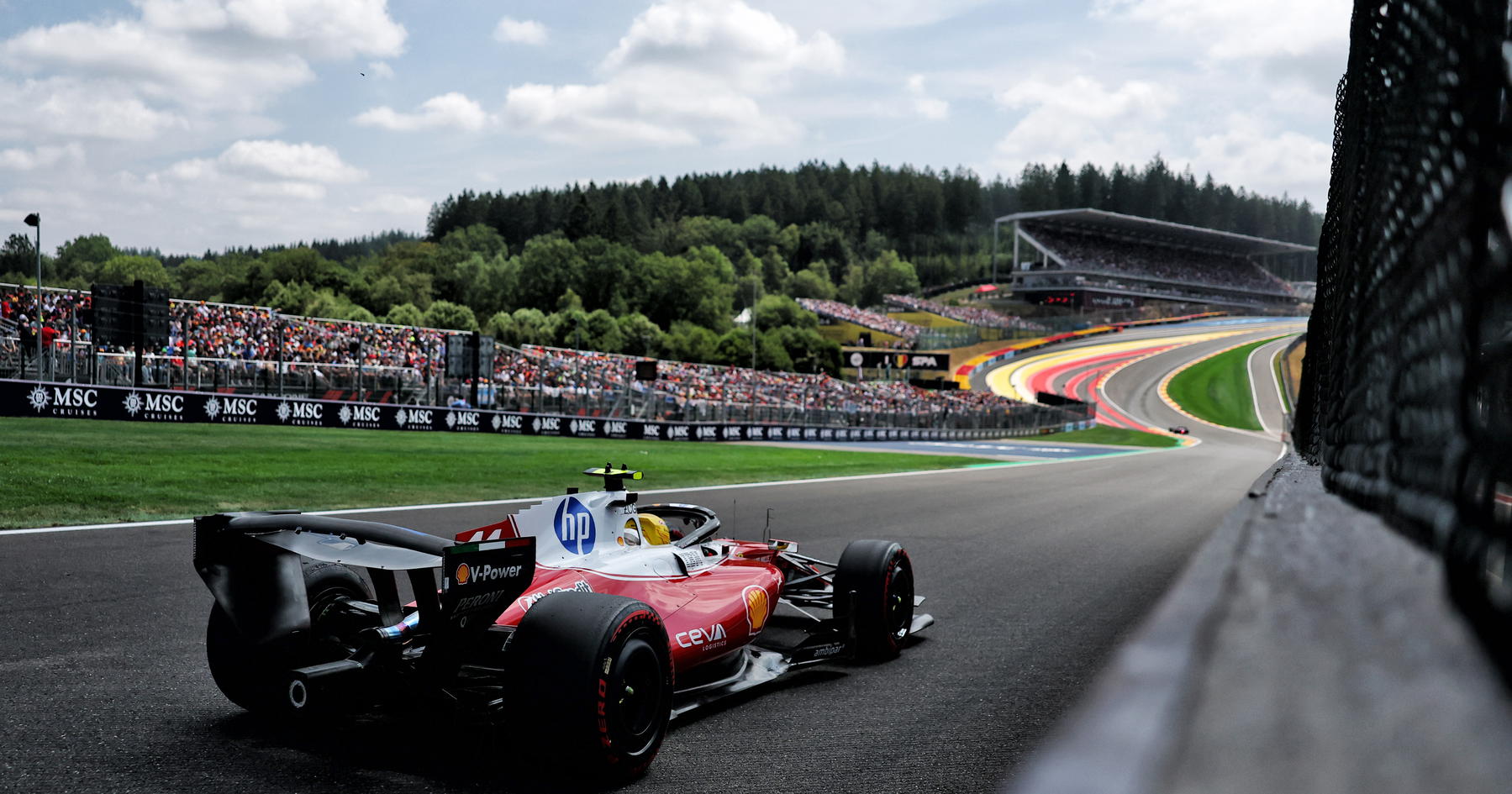
The SF-26's strong showing at the Belgian Grand Prix has prompted widespread speculation about Ferrari's prospects heading into Hungary, and understandably so.
The Hungaroring's tight, twisty layout demands maximum aerodynamic downforce, a configuration that has historically suited the SF-26's characteristics well.
With Lewis Hamilton and Charles Leclerc set to race a high-downforce specification at the circuit, optimism around Ferrari's chances has been building steadily in the paddock.
That optimism, however, has also generated a degree of confusion, specifically around what Ferrari's rear wing will actually look like in Budapest and what it represents in terms of development.
Every team will run a high-downforce wing package at the Hungaroring as standard practice, and Ferrari will be no different. The SF-26 will feature adapted front and rear wings to suit the circuit's demands.
But the nature of the rear wing change deserves a careful explanation, because the narrative forming in some quarters is not entirely accurate.
Not a new Macarena, just a circuit-specific addition
The rear wing Ferrari will field in Hungary is not a version 2.0 of its now-famous tilting rear wing, which has become known in the paddock as the "Macarena." It is neither an evolution of the tilting mechanism itself nor of the wing's core operating concept.
What Ferrari has actually done is considerably more straightforward: two smaller profiles have been added to the trailing edge of the wing, similar in design to the central profile that has featured on the Macarena since its introduction.
These small angular elements increase local downforce and allow more precise management of airflow when the wing opens and tilts fully. The modification is circuit-specific, tailored for high-downforce venues, and has no bearing on the development trajectory of the Macarena concept itself.
This distinction matters, because Ferrari's aerodynamic department is genuinely working on a true Macarena 2.0, and that project is already well into its development phase. Unlike the Hungary tweak, the real EVO specification is being designed with high-speed circuits in mind, and it is expected to make its competitive debut at Monza for the Italian Grand Prix.
The contrast in objectives could hardly be more stark. The Hungarian modification adds profiles to generate more downforce, a high-drag, low-speed solution.
The genuine Macarena 2.0 is being developed to reduce drag and enhance performance at circuits like Monza, where outright speed on the straights is decisive. The two developments are therefore pulling in entirely opposite directions.
Labelling the Hungary specification as a new version of the Macarena is, simply put, incorrect. It conflates a circuit-specific adaptation with a fundamental development step, and in doing so attributes evolutionary significance to a change that Ferrari has designed purely with the Hungaroring's unique demands in mind.
Originally published by RacingNews365 —
Read Original Article