

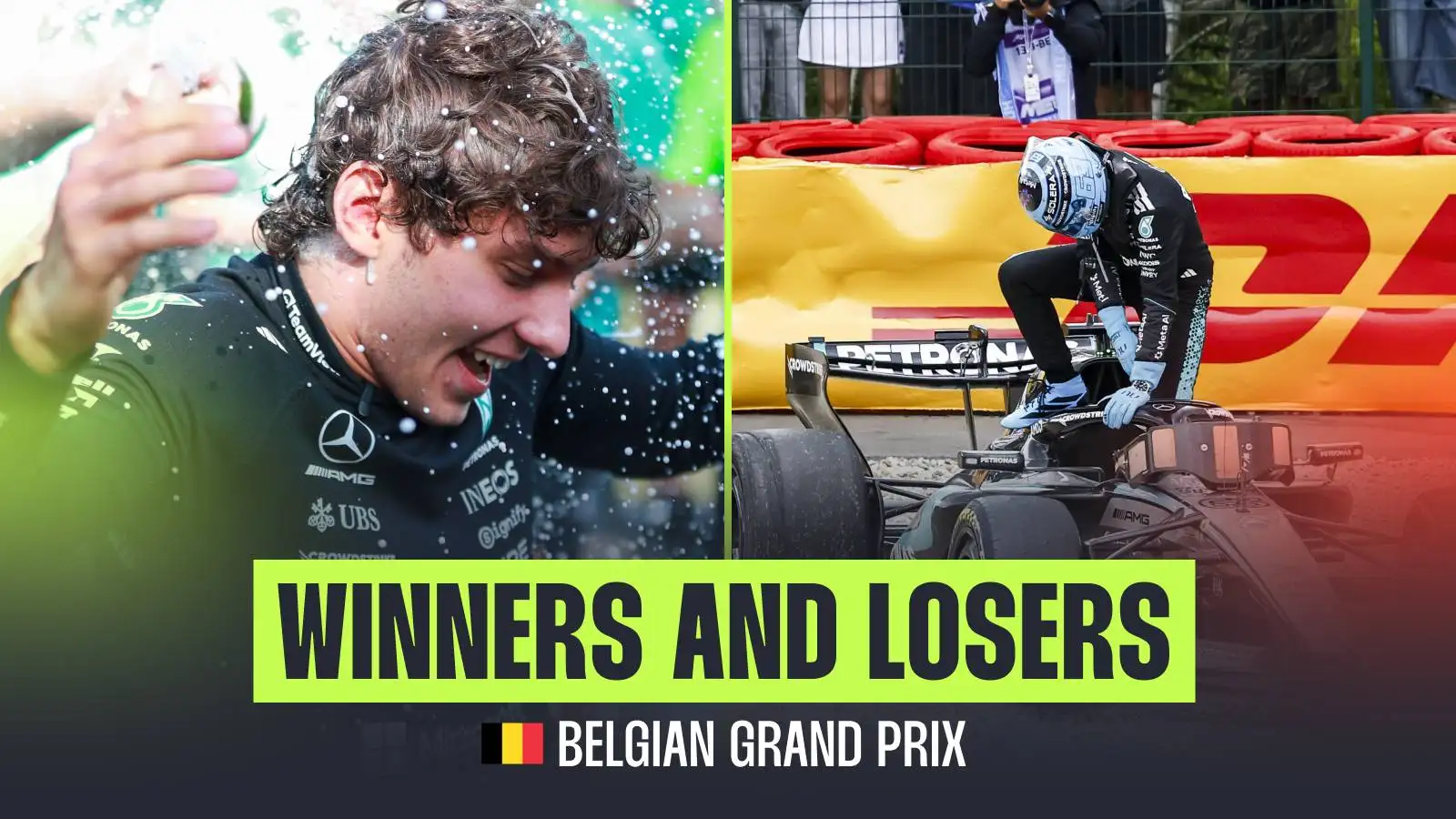
Kimi Antonelli took a decisive step towards a maiden championship title, on what was a miserable day for George Russell.
Here is PlanetF1.com’s full list of winners and losers from the 2026 Belgian Grand Prix.
Winner: Kimi Antonelli
The teenager took a huge step towards his maiden title as he bounced back from his recent disappointments with a weekend in which no one looked to have his measure.
Strong through practice, his pole position was briefly threatened as Max Verstappen passed him with a bit of battery boost into Eau Rouge, but he quickly was back in front of the Red Bull.
The only real threat to his win was the timing of the Virtual Safety Car, which allowed Charles Leclerc an opportunistic pitstop, but Antonelli wasn’t to be resisted as he caught back up on the Ferrari and overtook into Les Combes.
“I was a bit annoyed, but you can’t predict these things,” he said of the VSC.
“Sometimes it goes your way; other times it doesn’t. In Suzuka, I was very lucky with the Safety Car timing, and today it wasn’t on my side.
“But it’s how it goes, and that’s why, despite everything, you just try to make the best out of it and maximise the result.”
12 months ago, Antonelli spent his Belgian GP in tears as he came through the lowest point of his rookie season. Unable to find performance, he was open about his discomfort behind the wheel, getting inside his own head as he realised he was driving in a conscious manner that was both unnatural and littered with mistakes.
The improvement since then has been astronomical. While some of this could be attributed to the regulations reset and Antonelli exploiting the unique requirements of the power units, the Italian driver is simply delivering on every weekend, on a wide variety of circuits and against very strong opponents.
Coming out on top against Leclerc and Verstappen is no mean feat, and, with every race, Antonelli’s self-belief is only being bolstered further.
Loser: George Russell
In stark contrast to how smoothly things are going for Antonelli, George Russell can’t catch a break at the moment.
For yet another weekend, the British driver was combatting a straight-line speed issue that became mostly evident in the third sector of the lap – suggesting a vagary of the battery deployment or the AI ‘self-learning’ aspect of the same.
It’s a shame that Formula 1’s regulations have introduced such nonsensical complexities, which I’ll return to later in this column, but it’s of precious little comfort to Russell that his natural talent is being overshadowed by things that simply shouldn’t be of consequence to a driver.
A battery issue on his car meant he was left without deployment along the Kemmel Straight, leading to his being swamped into Les Combes, with Russell and Hamilton clashing on the apex – a collision of no particular blame (!), but instigated entirely because of the mystery power less.
For perhaps the first time, the true extent of Russell’s frustrations boiled over as he exclaimed about the weekend being “un-f**king-acceptable” as his issues mounted up.
This has kicked off the usual conspiracy theories across social media, with fans decrying ‘sabotage’ of Russell’s championship bid by means of small but accumulating hindrances, with the suggestion being that Mercedes is eager to avoid a 2016-esque situation between its two drivers.
But it’s worth remembering that Russell was quite open about his own performances not being what he expected of himself up until quite recently and, while the technical issues of the last two weekends have been frustrating, Mercedes is far from isolated in the fact there have been deployment problems and power unit idiosyncrasies that have left these highly competent engineering departments scratching their heads.
“There was definitely something on the engine that we have identified that meant he had less energy to to deploy – into Turn 18, that was the most visible,” Wolff said.
“It’s good that we spotted it here because, in Budapest, which is not energy-starved, it would have been more difficult to identify.
“That probably accounted for half the gap, or a little bit more, that he had to Kimi. All Mercedes engines had a lack of energy out of Turn 1, so that wasn’t only George. It affected him more than Kimi, but also Kimi had that issue to a certain degree, and that meant that he didn’t come out at the end of the straight in P3, but in P5.”
What Russell must cling to after the summer break is that Mercedes won’t seek to call off the championship and ringfence an Antonelli championship win – at least for now.
“This is a Constructors’ Championship as much as a Drivers’ Championship,” Wolff said, when asked by PlanetF1.com about the possibility of Mercedes weighing in behind Antonelli’s 45-point lead.
“We would never take a victory away from any of the drivers. So if it is George who is ahead, even though he’s behind in the championship, at that stage of the season, we wouldn’t do that.”
The headache facing Russell over the second half of the championship is entirely within his own head: does he share the doubts of the conspiratorial faction of his fanbase? And how certain is he that the technical issues aren’t having a knock-on effect on his driving, as he tries to take a step ahead of his seemingly unshakeable teammate?
Winner: Charles Leclerc
Off the back of his British Grand Prix, Leclerc made it two great races in a row to take the fight to Antonelli once again.
With the Spa-Francorchamps circuit exposing the Ferrari power unit power deficiency to a greater extent than Silverstone, due to the fewer corners through which the drivers could make up time, Leclerc nonetheless joined in the battle for the victory.
This was helped considerably by the timing of a soft VSC interruption that allowed him to make a quick pit stop, but Leclerc was ultimately powerless to prevent Antonelli from catching and passing him again.
Despite this, the wobbles that Leclerc seemed to be going through a few races ago now seem to be behind him, although he was very fortunate to escape penalty for his clash with Oscar Piastri – an incident that looked like it merited one.
“I’m confident in saying that I made a step forward,” he said.
“Whether I’m at the level where I want to perform, not yet. There are still things in the car that I need to drive around. I cannot drive completely naturally, and that is slowing me down in some parts of the race.
“So, there are still things that I’ve got to work on in order to be better. But surely it was a step forward, and for that I’m happy.
“I’ll continue with the one-race-at-a-time approach because, with these cars, it’s very difficult to be confident that if one race weekend goes well, the other one will, because it relies on such small details.
“With what you do with your driving, it’s never a given that you get the same deployment from one lap to the other, and that’s maybe the frustrating bit about these cars.”
As for Hamilton, the seven-time F1 World Champion’s weekend was on the back foot from the moment he crashed at the end of FP3, which resulted in his setup and feel being slightly off what he had had once qualifying began.
Any chance of a podium went begging when he picked up damage in the incident with Russell, for which the stewards gave him a penalty – a harsh decision, given it was on the first lap and the onboards showed neither driver had done a whole lot wrong.
With Hamilton later striking a mechanic at his pitstop, thankfully resulting in no injuries, it was a weekend in which the ultimate potential wasn’t quite utilised, but fourth-place was still a decent return.
More from the Belgian Grand Prix
Belgian GP 2026 Driver Ratings: Antonelli delivers, Verstappen shines, McLaren left wondering
Belgian GP conclusions: Spa sacrilege, Russell rattled, Verstappen temptation
Loser: McLaren
Could Lando Norris have won the Belgian Grand Prix?
The British driver certainly felt as though he’d have had a chance, if he’d started from the third-place grid slot he’d qualified in, of at least scoring a podium.
But, starting from 13th, this quest was always unlikely and, when McLaren didn’t make the most of the VSC interruptions to pit, Norris’ loss of time, together with a slow stop, meant he essentially acquiesced 15+ seconds of race time to those around him.
Seventh place for Norris was a meagre reward for a weekend on which McLaren was somewhat confused as to why the characteristics of Spa suited it so much better than Silverstone did, but the British driver was at least happy that his new power unit was doing roughly what it should – even if such things are not under his control.
“It’s just down to hoping you get lucky that the power unit does what it should do and doesn’t do something silly,” he said.
“Honestly, it’s been costing me the whole year. This is the first weekend I think all season I’ve been competitive in the straights, so the first time I’m probably happy.
“So I’ve had the problems all season, and this is the first race I’ve had where, actually, I’ve been the one that’s like, ‘Oh, I’m happy in the straights for once’, and it was the first time Oscar was the one a little bit on the back foot in qualifying.
“But it’s also not up to him. It’s just down to the power units doing whatever they want.”
Piastri, who took fifth place, spent his race combatting damage to his car from his clash with Leclerc, for which the Australian had every right to feel aggrieved by. Rather than calling for a penalty, he felt Leclerc deserved a black-and-white flag warning, pointing out that he had had “nowhere to go” in the incident.
Instead, Piastri was one of the drivers most critical of how the power units have affected the racing in F1 2026, saying that the power unit dynamics “suck” and that it’s a “pretty crap way to go racing”.
Given Piastri’s usual diplomacy and reluctance to stick his head above the parapet, he must really dislike what the sport currently is…
Winner: Max Verstappen
A typically well-executed race from the Dutch driver, who briefly shot into the lead as the pack approached Eau Rouge.
As has become the norm this year, this wasn’t down to any particular derring-do on his part, but rather due to “too much deployment” of his battery on the run down the hill.
“Then I went through Eau Rouge, looked at my battery status and thought, ‘Well, that’s going to be a difficult run to Les Combes’,” Verstappen laughed later.
“I expected Kimi to come by, and then I looked in my mirror and just saw a red rocket [Leclerc] coming. I was like, “Oh, I’ll just hold my line because if I move here, we’re going to have an airplane shunt.” So, it was pretty incredible, the differences.”
On a weekend where Red Bull sacrificed some performance by going back to the old rear wing as it works on a safety solution for the ‘Macarena wing’, the fact the car was in a decent window right from the start of the weekend might give the four-time F1 World Champion pause as he continues to weigh up his future options.
Red Bull is still very clearly a capable team, and the Austria upgrades do appear to have unlocked better performance, despite the emotions of the post-Silverstone weekend.
With Max and Jos Verstappen departing the paddock together with Laurent Mekies on Sunday night, the immediacy of these charged feelings now appear to have passed, although that doesn’t change the fact that Verstappen’s escape clause conditions are set to be reached after next weekend.
It was also a great race from Isack Hadjar, with the French driver embarking on an unusual strategy as Red Bull made the most of the early Safety Car to pit on two consecutive laps to cycle through the mandatory second tyre compound usage requirement.
42 laps on the hard tyre was a big ask, but Hadjar made it work to come home in sixth place, just 12 seconds behind Verstappen despite starting at the back, in a race Mekies described as his “best of the season” as he showed “top three” pace, while the driver himself declared it his most “complete” outing so far.
Loser: Haas
Esteban Ocon was lucky to still be in the race after a Lap 1 moment of contact between himself and Ollie Bearman resulted in him skating off into the gravel and barely avoiding the barriers.
This was a situation created by a “wrong place, wrong time” positioning as Ocon and Bearman both attacked Audi’s Nico Hulkenberg, but the French driver pointed out that, due to having another set of hard tyres and the Safety Car, it didn’t affect his race much.
Ocon’s discomfort with the Haas was a constant issue again at Spa, as he pointed out that, aside from Suzuka and Silverstone, he’s had precious few races without the parts inconsistencies that have resulted in a lack of confidence behind the wheel.
As for Bearman, he picked up a puncture in the Ocon clash and also struggled with his gearbox as he got “locked” in fourth gear and lost further positions – this issue being caused by oscillations that put the gearbox into a safety mode, an experience he hadn’t encountered before.
“Decent pace” went begging on this occasion.
Winner: Gabriel Bortoleto
The potential inherent with the Audi car is something that looks like it’s slowly being unlocked by the Hinwil-based squad, with Bortoleto taking eighth place to win the battle of the midfield ahead of the faster Racing Bulls car of Arvid Lindblad.
With the Audi power unit lacking compared to the RBPT and Mercedes power units in the back of the Racing Bulls and the Alpine, respectively, Bortoleto nonetheless executed a perfect race to finish as best-of-the-rest behind the leading four teams.
This was helped considerably by an opportunistic stop under the VSC on Lap 20, and Bortoleto had to soak up pressure from Lindblad for the rest of the race.
“It was tough,” he said.
“I could see that he was catching me massively in Sectors 1 and 3, and I knew I had to nail Sector 2 perfectly, all the corners, all the laps for like 25 laps, and every time I was missing a tiny bit an apex of a corner, I really felt it, and I could see the delta in my steering going lower. So it was very intense.
“I think the team did an amazing job today. Good strategy. I think we managed to extract everything we had today. We extended the first stint, we got the VSC, and then we were alone. We had free air, and we managed to put some great laps out there.”
Loser: The F1 2026 regulations
As I wrote in the qualifying Winners and Losers, there’s little need to pile on the regulations too much, given the changes that have been agreed for 2027 in a bid to resolve the issues that have been created by the new power units.
But there is still a lingering sense of malaise about what has been lost in this era, one in which drivers’ performances are completely overshadowed by what the power units do – particularly the ‘AI’ self-learning side of the deployment algorithms.
With the cars being so starved for energy at the high-speed Spa circuit, the techniques used by the drivers to try regenerating as much as possible led to a near-universal complaint from them about the inconsistencies down the straights.
As an example of just how easily tripped up the complex systems can be, McLaren’s Andrea Stella pointed to how parameters such as the topography of the circuit – such as the hill at Eau Rouge – can be mapped into power unit modelling, but factors such as wind can wreak havoc.
“If you have much more headwind, then the straight would last longer, and then this would be a parameter that you would not necessarily include in a very robust way in your modeling,” he said.
“Because this in itself, yes it has a certain random character, but some of the other characteristics they are actually well represented in the models.
“That’s why we talk about wind, grip level, drivers’ input. These things may be more difficult to be captured in modeling and therefore in a simulation.”
As some of the drivers said, it’s disappointing that F1 has evolved into a formula in which so many aspects of performance are no longer entirely within the driver’s control.
Overtakes for the lead, such as Antonelli’s on Verstappen on Lap 1 or, later on Leclerc, lack a sense of importance or magnitude – F1 has essentially created a situation where, to use a football analogy, the goalmouths have been made larger. Yes, there may be more goals and, therefore, ‘more excitement’, but it’s merely a diluted product.
Thankfully, this malaise won’t happen at every track, but what does it say about Formula 1 that such iconic race tracks such as Spa have been so castrated – to the point where the true picture was clouded through clever use of onboards (or lack thereof), or removal of live speed readings in favour of ‘G-force’ measurements?
The sooner this era so dominated by the inane banalities of these power units comes to an end, the better for everyone.
Want to be the first to know exclusive information from the F1 paddock? Join our broadcast channel on WhatsApp to get the scoop on the latest developments from our team of accredited journalists.
You can also subscribe to the PlanetF1 YouTube channel for exclusive features, hear from our paddock journalists with stories from the heart of Formula 1 and much more!
Read Next: Martin Brundle: ‘Get rid of this concept as soon as possible’
Originally published by Planet F1 —
Read Original Article