

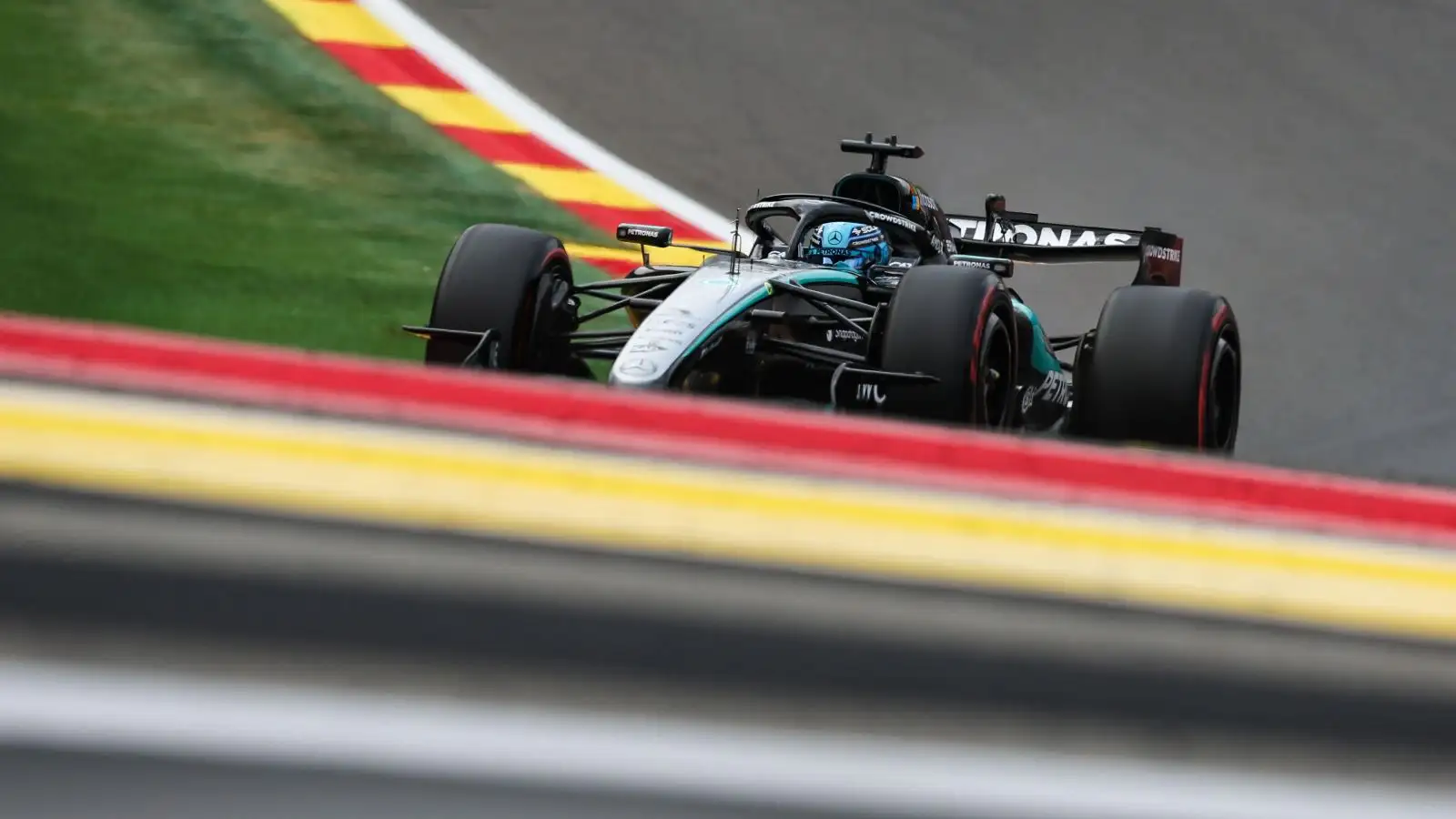
Kimi Antonelli took pole position for the Belgian Grand Prix, and also tops the Winners and Losers list from qualifying.
Here is PlanetF1.com’s full list of winners and losers from the 2026 Belgian Grand Prix qualifying.
Winners and losers from the 2026 Belgian Grand Prix qualifying
Winner: Kimi Antonelli
It’s testament to Kimi Antonelli’s stellar season that it is no longer surprising or shocking to see the Italian teenager beat everyone around him. In fact, there’s almost a sense of inevitability starting to creep in as Antonelli’s consistent performances mount up.
Antonelli had looked exceptionally strong through practice, but his pole position on Saturday wasn’t a foregone conclusion, having felt “lost” in Q1 when the conditions didn’t seem quite right for Mercedes.
“The wind picked up a little bit and the balance was a bit more on the edge,” he said.
“But then, obviously, the session came to us, and Q3 was good because we did a decent first lap and then, on the second lap, found a lot of time. But, yeah, I feel like the track was cooling down and it was helping us a little bit. It was a good lap, and now we’ll focus on tomorrow.
Adjusting the front wing flap on his W17, this small change, combined with tidier driving in Q2, played a big part in the turnaround, and it sets up a wonderful front row with Antonelli ahead of Max Verstappen.
A sustained wheel-to-wheel battle between Antonelli and Verstappen is something we’ve been teased for a while, but hasn’t yet quite unfolded: might Spa deliver the goods?
Loser: George Russell
The growing sense of inevitability around Antonelli being up at the front has coincided with a similar feeling that Russell isn’t in the right place to make it a Mercedes 1-2 on any sort of consistent basis, despite the general competitive level of the car.
This proved to be the case on Saturday in Belgium, with Russell never quite looking to have the measure of his precocious teammate throughout practice.
But there is a valid reason for the difference in performance, and it (mostly) comes down to straight-line performance.
What is evident from the data is that Russell is indeed suffering from a slight straight-line deficit relative to Antonelli, which is accounting for some of the gap between them.
This is most evident in the third sector, with no deficit evident on the blast from La Source all the way down the Kemmel Straight down to Les Combes during the first sector of the lap.
But, by the time both he and Antonelli made it to the final blasts of the lap, a speed differential of several kilometres per hour opens up – it’s not to do with the brakes, and it’s not to do with the power unit (according to the man himself).
The working hypothesis within the team has been suggested to be down to driving style techniques: in this very modern and not-quite-natural Formula 1, the conservation of momentum through corners is not just critical for immediate laptime, but also in terms of energy conservation for later in the lap as the effects compound – being slower out of Blanchimont may be down to a smidge more energy being used under acceleration half a lap ago.
Is Russell’s straight-line deficiency simply down to Antonelli conserving a greater level of energy through higher corner momentum, with the Italian being fractionally more adept at the rather unique demands of this regulation set?
And, if that’s what it comes down to, does that make Antonelli the ‘better’ driver of the two, or merely the more effective at exploiting these idiosyncratic requirements?
Winner: Max Verstappen/Red Bull
Red Bull’s RB22 performance levels might be inconsistent but, when the car is in the right window, it’s clear there is some potency in the package, even if it is lacking a little straight-line speed.
Sans the ‘macarena wing’, the Dutch driver was open about the fact his three-tenths of a second deficit to Antonelli might have been double that without the aid of a substantial tow through the final sector from his teammate.
Isack Hadjar, whose qualifying session focused on getting into Q3 solely for that purpose as his own position was made less important by the fact of his engine grid penalty, timed his acceleration out of Paul Frere to perfection – allowing Verstappen to latch on immediately behind.
Indeed, so close to Hadjar was Verstappen that, watching Red Bull’s tactics with enjoyment from the media pen, Pierre Gasly opined that the Dutch driver may have been blocked through Blanchimont.
But, upon crossing the line, it was evident that Verstappen had definitely benefitted from his teammate’s efforts, landing him on the front row.
“It was close, but he did amazing,” Verstappen said of the moment.
“I initially thought, “Oh my God, it’s too close,” but then actually it worked out well to the last corner. It was close, but I trusted him.”
It’s in such operational sharpness and shrewdness that Red Bull has stood out in the past, and it was a welcome reminder of just what Verstappen’s squad is capable of.
Thanks to it, a wonderful front row is set up: Verstappen alongside the driver who may prove to be his heir apparent. Fingers crossed we don’t get a repeat of the Monaco damp squib, and actually see the pair go to battle.
More from the Belgian Grand Prix
New George Russell evidence emerges after ‘serious’ Mercedes issue
F1 starting grid: What is the grid order for the 2026 Belgian Grand Prix?
Loser: Oscar Piastri
McLaren’s new rear wing assembly is worth about “half a tenth” according to Lando Norris but, aside from that, it’s been a relative stable period of time in terms of upgrades for the Woking-based squad.
Despite this, McLaren has looked to have more pep in its step this weekend, with Norris feeling that the car has simply gelled a little better with a track of different characteristics.
But, while the British driver has been doing a “very good job”, in his own words, Oscar Piastri has struggled to keep the pace with his teammate – not helped by the disjointed practice day on Friday as he had a delayed start to FP2.
The Australian downplayed the impact of this when he spoke after qualifying, instead pointing to how he’s struggled to get the same level of confidence with the car that his teammate is feeling.
“The whole day has just been trying to get the car to work how I want it to and put it on the edge has been has been tough. So, not the easiest weekend,” he said.
“It’s just been a very difficult car to to drive. If you can balance it on the edge, then the lap time seems to be there. But balancing it on the edge is pretty tough.”
The high of the near-win in Japan feels like a long time ago now, and there’s no sign at the moment that Piastri can break free of this run of subdued anonymity.
Winner: Arvid Lindblad
Another strong showing once again from Racing Bulls, with Lindblad taking eighth place and Liam Lawson taking 11th – the pattern of double top-10 finishes only broken up by Audi’s Gabriel Bortoleto pipping the Kiwi driver.
“I’ve been driving really well all weekend,” a matter-of-fact Lindblad summed up later.
“I’m very happy with the the job that I and the team are doing. So maybe there was a tiny bit left, but I think everyone can say that.”
Explaining that he believed he could have achieved a 1:44 with a perfect lap, he even thought Piastri – one of the assumed eight drivers to be ahead of the midfield teams – was beatable.
“I think there’s a few things we could have managed better that maybe would have helped us to get Oscar today,” he said, but conceded this maybe only added up to a tenth at best.
Loser: The F1 regulations
It’s been a while since we’ve had a bitch about the regulations, given there was a sequence of races after Miami where the circuits were less exposing of the shortcomings.
But Silverstone harkened back to the fundamental flaws the new power units have introduced to Formula 1, and Spa-Francorchamps – usually one of the most joyous onboard experiences of the year – has been considerably neutered.
There isn’t a need to pile on with the negativity, given that this is the worst the situation will be as the power units evolve next year, but the fact of the matter is that a fast circuit like Spa simply does not offer ways for a car to regenerate energy – meaning that the cars are powering around some areas of the track with only half of their potential as they run on the combustion engine alone.
As one senior member of one of the drivers’ entourages explained to this writer on Saturday night, the drivers are either foot-to-the-floor through corners due to running on 400-450 horsepower, or are lifting off through the same corners – not due to the grip limitations, but merely to desperately claw back some energy for the next straight.
“Spa has been f**ked,” was the succinct summary of this discussion, which came after several of the drivers commented on the topic in their own media sessions – although held back on attacking outright, given the concessions that we all know now are coming.
“For most of sector two, you run just on the engine, so what is that? Four hundred and fifty, five hundred horsepower, something like that, which is, I guess, more or less what a Formula 3 car has, but with F1 downforce,” Verstappen said in the press conference.
“So, you can imagine, of course, that that is not very exciting to drive. But honestly, I don’t want to sit here and complain again because probably someone will shoot me outside the door.
“Like I said before, I’m mentally just adjusting to it, and I’m trying to make the best out of it, even though, of course, it’s not what I like or what I love to do in Formula 1. But I can also sit at home and drive nothing, and that also doesn’t do anything, so I’m just trying my best.”
Carlos Sainz said, “I think it’s clear that it’s we’ve lost quite a bit with these cars around around Spa.
“Having said that, I don’t want to keep belittling my own sport because it’s it’s not going to do any any good. So I think we all know this is not good enough. That it needs to change. It will change. It will evolve.
“Whoever saw these simulations in 2022, 2023, and, at the end, looked at it and say, how can we even accept that? It needs to review what happened there because yeah, it should have never happened.
“But, now we’re here. We are having some exciting races. The sport is still growing, so time to move on.”
Responding to Sainz’s comments, Lewis Hamilton said, “I don’t know who made the decision, but whoever it is, they still got their job”, before laughing.
What was also clear after qualifying was just how many drivers had their sessions impacted by deployment inconsistencies, with an example being Ollie Bearman’s ‘mistake’ being the positioning of a cockpit switch for deployment rather than being a driving error.
It has never been harder to get a true read on just how much impact a driver’s natural speed has on ultimate laptime and, at a circuit as pure and visceral as Spa-Francorchamps, the short-lived potency of these power units has resulted in some of that usual thrill being stripped away.
Want to be the first to know exclusive information from the F1 paddock? Join our broadcast channel on WhatsApp to get the scoop on the latest developments from our team of accredited journalists.
You can also subscribe to the PlanetF1 YouTube channel for exclusive features, hear from our paddock journalists with stories from the heart of Formula 1 and much more!
Read Next: F1 starting grid: What is the grid order for the 2026 Belgian Grand Prix?
Originally published by Planet F1 —
Read Original Article