

Formula ReportFormula Report

Search

Red Bull warned 2026 failure could trigger bombshell Max Verstappen exit
racingnews365.com·

Red Bull warned 2026 failure could trigger bombshell Max Verstappen exit

Former F1 driver Johnny Herbert has warned Red Bull that not being the quickest team in the upcoming 2026 season could trigger Max Verstappen’s departure. The past two seasons have seen Verstappen linked with an exit from Red Bull, with talks held with Mercedes during the first half of 2025. Ultimately, he expressed his loyalty to the Austrian outfit for this year, as F1 enters a new power unit regulation cycle. For Red Bull, this also marks the start of life as its own powertrain supplier, representing the biggest challenge in the history of the Milton Keynes-based team. While its engine looked promising during the Barcelona shakedown test, it remains to be seen how competitive it will be. Red Bull boss Laurent Mekies has already acknowledged that Verstappen is taking a risk by sticking with the team, given the scale of the task it faces. As highlighted by Herbert, the four-time world champion is not in F1 to “finish second”; the Dutchman wants to be on top and secure more world titles. For that to happen, he needs one of the best — if not the best — cars on the grid, putting pressure on Red Bull to deliver and retain the 28-year-old beyond 2026. Discussing what Red Bull must do this year to keep Verstappen, Herbert told RacingNews365 at Formula E's Miami E-Prix: "Go faster than all the others, very clearly, because he knows how the team works.  "But fundamentally, it’s all going to come down to the car you start the season with — whether it’s the quickest out of the box, one of the quickest, or very, very close. It might even alternate from track to track. "That’s where, as a racing driver, you’re always thinking: what’s going to benefit me over the next couple of years to win my next world championship? The only way they’re going to achieve that is by giving him a car he can challenge with. But challenging is one thing — you’ve got to beat the likes of, say, Mercedes, for example. "If they don’t, then he’s going to look elsewhere, because that’s what racing drivers do. He’s not there to finish second. His core mentality is to win, and when he doesn’t win, he gets very annoyed.  "But Lewis [Hamilton] is the same. Charles [Leclerc] is the same. George [Russell] is the same. All the drivers here in Formula E are exactly the same. They’re competitive animals, like all sportspeople are. Ultimately, it comes down to what they supply."
Mercedes highlight 'monumental' scale of F1 2026 journey
racingnews365.com·

Mercedes highlight 'monumental' scale of F1 2026 journey

Mercedes trackside engineer Andrew Shovlin has stated the F1 2026 rule change has been the “biggest project” the team has ever undertaken. The Brackley-based squad gave the W17 challenger its on-track debut at a shakedown at Silverstone before taking to the track on Monday in Barcelona as part of the first pre-season outing. A brand new power unit has been built by Mercedes, as well as a fresh chassis with vastly different aerodynamic rules. With the engine in production for several years, Shovlin asserted the scale of the project has not been lost on the team. “It has been an absolutely monumental project,” he said. “And on the power unit side in Brixworth, they've been working on it for years. “It’s a very, very difficult and challenging program. You've also got all the complexity that the fuel development throws into that with Petronas. “And then on the chassis side, a completely new set of regulations. Coupled with that, we've got all new electronic systems. “It’s the biggest project we've ever done as a team.” Both George Russell and Kimi Antonelli got behind the wheel on Monday, tallying 151 laps between them. It marked a strong start for the team, who is hoping to enter the year ahead of title challengers. “We don't know where we stand in terms of performance, but we are able to keep the car out on track, which is great because we'll be able to hopefully learn at a good rate,” Shovlin added. “It’s a testament to, in some cases, years of preparation for these early days.” Mercedes' strong start continued on Wednesday, with Russell tallying 92 laps in the morning segment.

Ferrari changes course with radical new concept
racingnews365.com·

Ferrari changes course with radical new concept

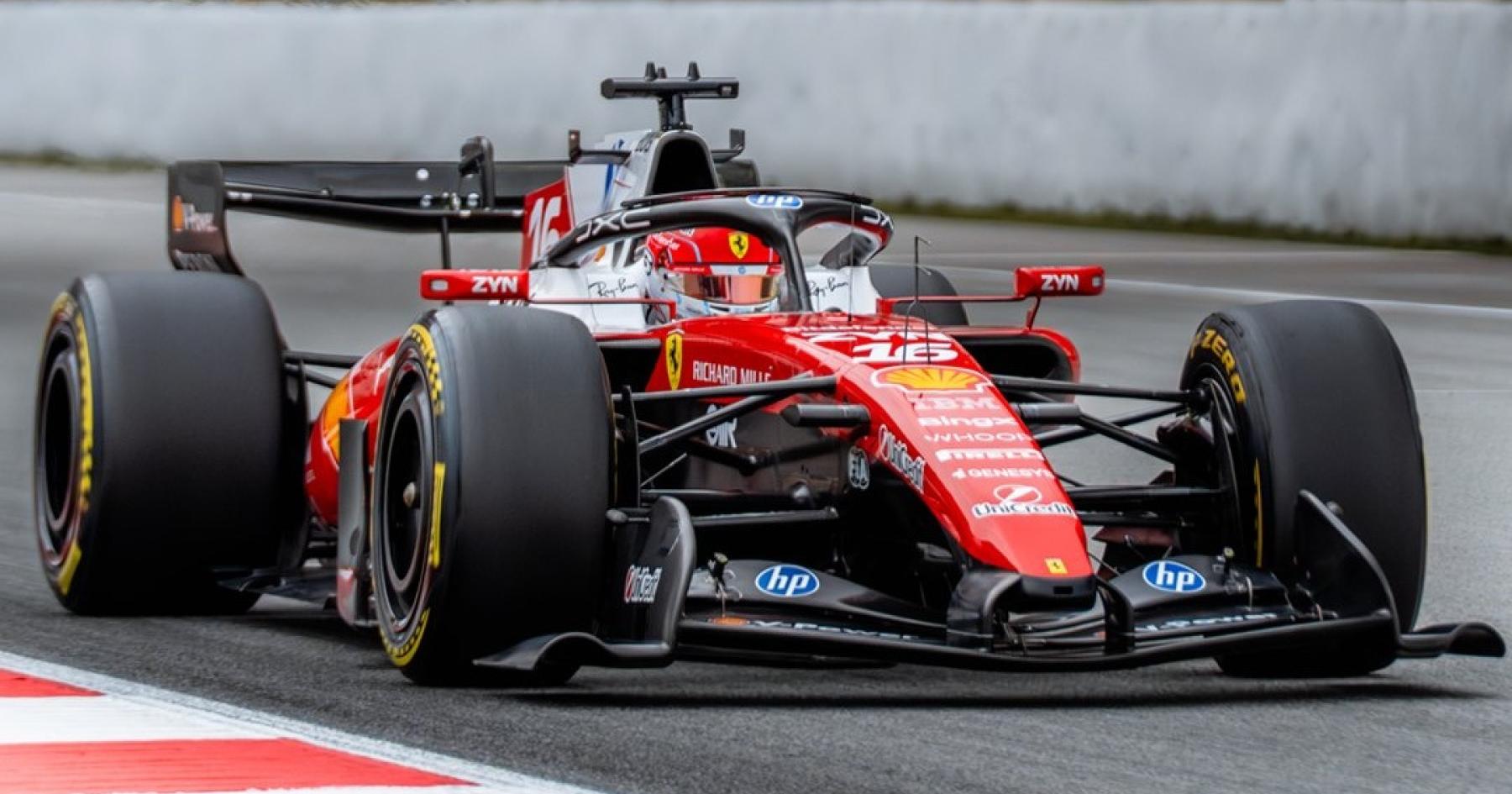
Ferrari pulled back the curtain on their SF-26 challenger at precisely 11am local time on Friday morning, offering the first glimpse of how the Scuderia intends to tackle the sweeping regulatory changes coming in 2026. The images reveal a machine shaped by the extensive aerodynamic and power unit revolution that will define the new era, though what has been shown represents merely the starting point for a project that will evolve considerably before the season opener in Melbourne. Several core design philosophies are already apparent in this early iteration. Most notably, Ferrari have committed to push-rod suspension at both ends of the car, finally abandoning the troublesome pull-rod setup at the front that plagued the SF-25 and left drivers struggling with steering feel through corner entry phases. Ferrari alone in nose approach The front wing assembly demonstrates Ferrari's approach to the mandated active aerodynamics systems.  Rather than the profiles themselves, it is the actuators controlling flap incidence that catch the eye, cleverly integrated within the endplates. Short, curved pylons connect the nose to the wing assembly, creating a cleaner overall package. However, it is the sidepod architecture that reveals the most sophisticated thinking. The high-mounted air intakes, carried over from previous designs, now conceal a deeper channel beneath that feeds into a bypass duct.  This innovative solution exits at the base of the engine cover, positioned immediately behind the IBM branding. Ferrari's air intake design When viewed alongside the power unit air intake, an almost triangular cross-section with rounded edges that appears remarkably compact compared to rival solutions, these elements suggest Ferrari have pursued a fundamentally different internal airflow strategy. This approach indicates significant attention to power unit packaging, extending to the radiators and heat exchangers that must operate within tighter confines.  The rear of the SF-26 appears notably narrow, particularly around the hot-air exit zones, reflecting a focused approach to airflow management that should enhance the diffuser's ability to extract air from beneath the floor. Ferrari's bold engine cover The substantial shark fin adorning the engine cover partially echoes last year's design language whilst incorporating a distinctive saw-tooth profile that breaks new ground for the Italian squad. Regulatory requirements have forced the wheelbase down to 3,400mm, resulting in a noticeable rearward shift of the cockpit position. The change is significant without being excessive, maintaining the car's proportional balance whilst meeting the new technical requirements. Beneath its provisional appearance lies a machine concealing numerous refined characteristics, one that will undergo substantial development before Lewis Hamilton and Charles Leclerc take it to the grid in Australia.  The SF-26 represents Ferrari's bold interpretation of how to extract performance from F1's most significant regulatory shake-up in decades.

A year on since Lewis Hamilton broke the internet
racingnews365.com·

A year on since Lewis Hamilton broke the internet

Exactly one year ago today, Lewis Hamilton stood outside Enzo Ferrari's house in Modena, dressed immaculately in a Ferragamo three-piece suit, posing beside an F40.  The image, posted on 20 January 2025, became the most liked Instagram post in Formula 1 history, amassing 5.7 million likes and reaching 25 million views on X. It was a moment of pure theatre, capturing the weight of expectation placed upon Hamilton to restore Ferrari's glory after 17 years without a constructors' championship.  The seven-time world champion's carefully curated appearance, complete with reports of him speaking Italian, signalled his total commitment to the Scuderia. What followed, however, was anything but glorious. Article continues below the Instagram post... https://www.instagram.com/p/DFC5g6WsxQW/?utm_source=ig_web_copy_link&igsh=NTc4MTIwNjQ2YQ== View this post on Instagram A post shared by Lewis Hamilton (@lewishamilton) Hamilton's nightmare 2025 in red Hamilton's 2025 campaign became the worst of his career. For the first time since joining F1 in 2007, he completed an entire season without a single grand prix podium.  His only appearance on the top step of a rostrum came in the China Sprint last March, an anomaly that only highlighted how dire his Sundays became. The numbers tell a brutal story. Hamilton finished sixth in the championship with 156 points, 86 behind teammate Charles Leclerc's 242.  He averaged four positions below Leclerc in qualifying and suffered a historic collapse at the season's end, becoming the first full-time Ferrari driver since 2009 to qualify last.  Three consecutive Q1 eliminations from Las Vegas to Abu Dhabi capped a nightmare he openly described as such. The SF-25 was fundamentally flawed. A backfiring suspension change, an extremely narrow operating window, and braking instability plagued the car.  After both Ferraris were disqualified in China for plank wear and weight violations, the team was forced into conservative setups that sacrificed performance.  Hamilton, adapting to machinery built without his input after 12 Mercedes years, never found comfort with the driving style required. Article continues below... Hamilton's 2026 reset Ferrari made a calculated decision in April 2025, stopping major development after determining the SF-25's concept carried irreparable limitations. Everything pivoted to 2026, where sweeping regulation changes offer a clean slate for all teams. The new rules introduce lighter, more agile cars with active aerodynamics, redesigned hybrid power units with an even split between combustion and electric power, and a manual override system replacing DRS. It represents the most significant overhaul in F1 history. For Hamilton, 2026 is critical. Reports suggest Ferrari are developing a split strategy to suit both him and Leclerc, with a third sidepod concept planned for the Australian season opener in March. Three separate pre-season testing sessions, starting in Barcelona on 26 January, provide crucial preparation time. That viral photograph from a year ago promised a fairytale ending to Hamilton's career. Instead, 2025 delivered pain.  Now, the 41-year-old faces his last great challenge: proving the dream is merely delayed, not dead.

F1 warned over 'huge variation' ahead of 'dynamic' 2026 F1 season
racingnews365.com·

F1 warned over 'huge variation' ahead of 'dynamic' 2026 F1 season

Haas team principal Ayao Komatsu believes "two elements" will contribute to what he feels will be "a huge variation" between the F1 teams as they fight to get to grips with the new regulations for this season. As the days count down towards the start of the new season in Australia in early March, the teams are at present unveiling their cars, albeit predominantly liveries only, as they keep their cards close to their chests regarding the aerodynamics. In tandem with the introduction of a new power unit, comprising a 50-50 split between combustion and electrical power, and run on 100% sustainable fuels, the bodywork of the cars has also undergone a significant overhaul in a bid for closer racing and improved overtaking. The natural early concern, however, is that the PU, in particular, will prove to be a major performance differentiator, as was the case in 2014 when the 1.6-litre turbo-hybrid engines were introduced, and Mercedes went on to dominate. The aero packages will also spark a major development race, and the pecking order could vary greatly from beginning to end, according to Komatsu. "There’s going to be a huge variation between teams because of two elements," said Komatsu, following the unveiling of the VF-26. "First is the PU, with the teams using the same provider presumably bunched up, so Mercedes providing four teams, Ferrari providing three, Red Bull two, Audi and Honda providing one. "Then on the aerodynamic side, it’s completely open, and development will happen fast. A pecking order may get established in the first four races pretty quickly, but I think it’s going to be a very dynamic season. "What you see in race one and race two, I expect will be totally different when we come to the final races of the year." As to where Haas will land in the shake-up remains to be seen. Komatsu simply wants to see progress, with the power unit and how to best utilise the deployment of the energy crucial to that. "Firstly, before we go racing, and even testing, we need to get on top of energy management, that’s the huge one," he said. "I don’t know if we all understand the full extent of the challenge because we don't know what we don't know. "Then, with aero development, we’re reasonably happy with what we've done so far, but as with all new regulations, the question will be, is the target we’ve set good enough? "When we get testing, I'm sure we’re going to see different concepts, and if we’ve missed something, we need to get on it very quickly." As to how his team will fare, Komatsu added: "For the first few races, rather than setting a sporting target, it's more a target for us. "First and foremost, get on top of PU management, then aerodynamic development. If we have to change direction or look at different concepts, again, we've got to do that promptly. "To be able to implement certain things quickly, you've got to work as a team and have clarity on communication. These are things we’ve been doing the last couple of years, and that's going to be tested even more, but I feel like we’re prepared."