
Formula ReportFormula Report

Search

Liam Lawson details team-mate priority in new Racing Bulls partnership
racingnews365.com·

Liam Lawson details team-mate priority in new Racing Bulls partnership

Liam Lawson has insisted maintaining a strong communication link with new team-mate Arvid Linbdlad will be key to Racing Bulls' season. Lindblad has received a promotion to F1 this year and will be the sport's only rookie driver for the upcoming season. He joins Lawson at the Red Bull sister team, who got their campaign up and running at the Barcelona shakedown this week. Given he is the more experienced driver in the line-up, Lawson will be leaned on more to steer the direction of car development, which is likely to prove crucial this year as F1 enters a new cycle of technical regulations. When asked to assess his relationship with Lindblad, Lawson said: “So far it has been good. “It’s a very different year to come into F1 with these cars. “So obviously for us, it's important to communicate well and work together on trying to build this car as quick as possible. So far, it’s been good.” Racing Bulls did not take to the track on Friday as it completed its three days of running prior to the final day of action. Next up for the team is pre-season testing in Bahrain in just under two weeks' time. Describing what will be on the team's agenda, Lawson said: “Honestly, just to keep learning. “It’s so early days at the moment, we're going to go to Bahrain on a very different track with very different climate as well. “It’s gonna be very, very different. It's going be great for us to learn how the car performs at very different places, different tracks. “Outside of that, the main goal is to just try and keep learning and improving the car and discovering what we can.”

Red Bull prepared for 'sleepless nights' in 'monumental' F1 challenge
racingnews365.com·

Red Bull prepared for 'sleepless nights' in 'monumental' F1 challenge

Red Bull team principal Laurent Mekies has insisted that the Austrian outfit is prepared for some "sleepless nights" in the opening rounds of the 2026 season, due to the "monumental" challenge of being its own power unit supplier. For the start of the new power unit regulations, Red Bull, with technical support from Ford, has taken on the huge task of designing and developing its own F1 engines, which will also power sister outfit Racing Bulls. It is a challenge that could see Red Bull face a very difficult season, particularly given its inexperience in engine development compared to the likes of Ferrari, Honda, and Mercedes. Becoming a power unit supplier has turned Red Bull into a fully fledged factory operation, but Mekies has insisted that the size of the project at hand cannot be overlooked. However, the team boss also feels that it is a challenge Red Bull is capable of meeting, but only if it manages its expectations. "On the other hand, again, this is something that only Red Bull can do," the Frenchman stated to De Telegraaf .  "That also means that we have to temper expectations in the first part of the season. We have to make sure we get the chassis and the engine going.  "After that, you will see that we will make progression. At least I hope so, but this team has always proven that over the years. "You have to look at it this way: the magnitude of this challenge is monumental. To develop your own engine from scratch, you shouldn't underestimate that.  "If you think we are immediately on the same level as the manufacturers who have been doing this for 90 years, that's not going to happen." Red Bull set for 'headaches' Becoming an engine manufacturer in F1 is a task that will require immense patience from the Milton Keynes-based outfit, particularly as it deals with failures for the first time. Red Bull did run on the first day of testing in Barcelona, with Isack Hadjar posting the quickest lap time, but Mekies, speaking before the test, knows the team will face some long nights. "We expect the first few months to be tough," added Mekies. "And that we will have headaches and sleepless nights, and that sometimes we will have trouble getting the car out of the garage.  "All true, but we also believe that we have the right people, the right partners and the right facilities to find our way up. Be patient and give us time."

Liam Lawson hands Red Bull major boost after promising opening day
racingnews365.com·

Liam Lawson hands Red Bull major boost after promising opening day

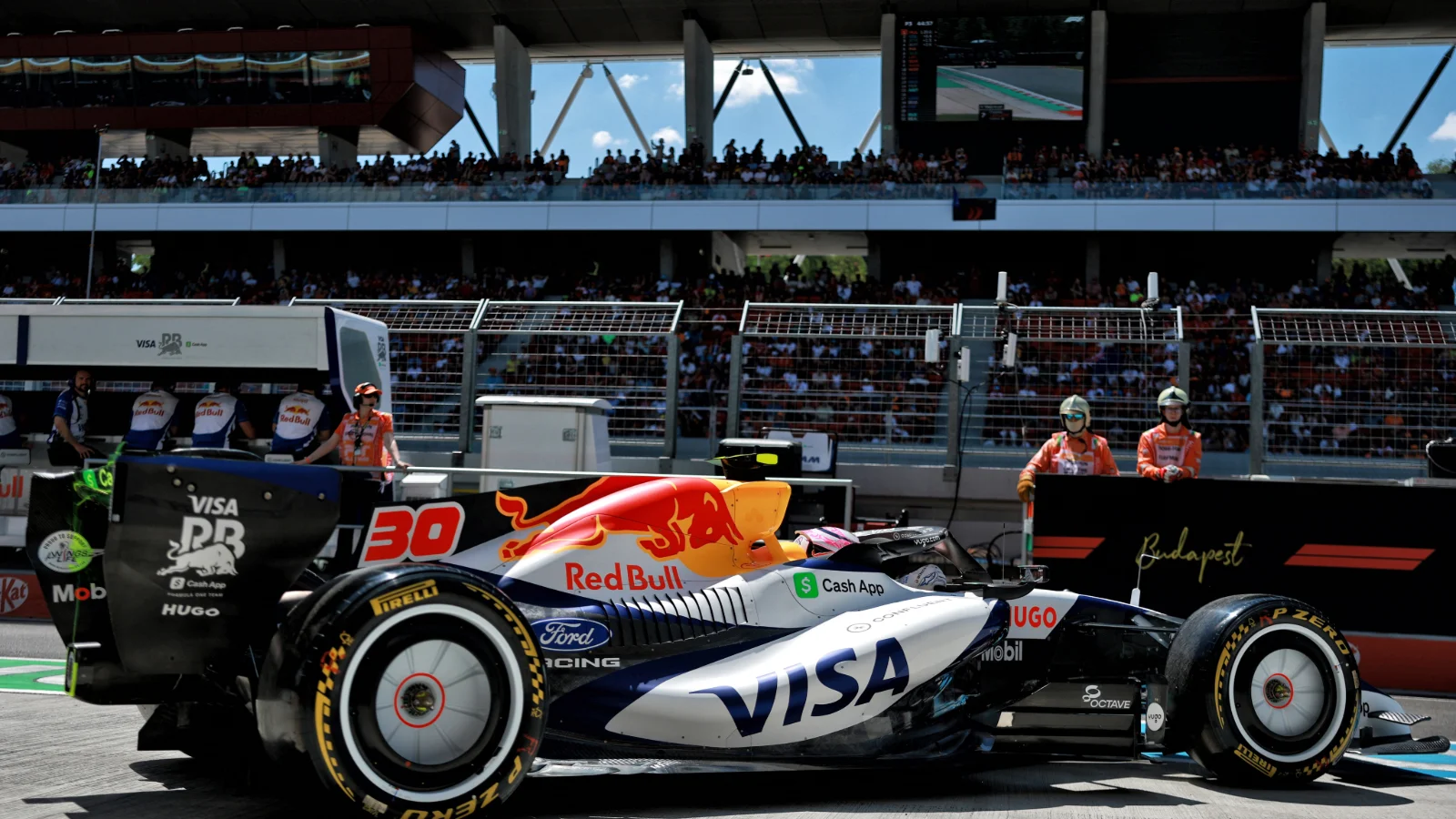
Liam Lawson has handed Red Bull a major boost following the opening day of the official shakedown test in Barcelona, revealing that its power unit felt "very good". The New Zealander spent the entire opening day of the five-day test at the Circuit de Barcelona-Catalunya behind the wheel of Racing Bulls' VCARB 03. Lawson clocked 132 laps across the day, with a best lap time of 1m 21.513, gathering valuable data for Red Bull's sister team. The data was also useful for Red Bull itself, with Racing Bulls being powered this season by the Milton Keynes-based operation. Unfortunately, the 23-year-old did cause a red flag towards the end of the morning session; however, he has insisted that the stoppage was purely a "safety precaution" rather than a problem with the car. It is a season of great unknowns for Racing Bulls, given that it is being powered by Red Bull, which has no previous experience of being an F1 engine manufacturer. Based on the opening day of running, though, it is so far, so good for both Racing Bulls and Red Bull's engine. Asked how the Red Bull power unit felt, Lawson told F1TV : I mean, it feels good, honestly, so far today. But it's very hard to tell. So the main thing is reliability.  "At the moment, we've done a good amount of laps today, only a few little things [went wrong]. And honestly, the only issues we really had today were safety precautions, not really any actual issues.  "So yeah, so far, honestly, on the power unit side, has been very, very good. But again, hard to know compared to everybody else where we're at, but definitely we'll keep learning over the next few days."

Red Bull surprise with aggressive design for Max Verstappen
racingnews365.com·

Red Bull surprise with aggressive design for Max Verstappen

Ahead of its on-track debut on Monday in Barcelona, Red Bull shared the first real images of its 2026 F1 challenger, the RB22. The car was driven on the track by Isack Hadjar, with Max Verstappen due to jump behind the wheel later in the week. Verstappen will be hoping the car gives him an opportunity to fight for a fifth F1 title after narrowly missing out on the championship last year to Lando Norris. The fresh images of the RB22 challenger already show clear differences from the first renders of the car that were revealed at its launch event earlier this month.  The most noticeable changes relate to the sidepods and side protection next to the cockpit.  In particular, it can be seen that the volumes of the sidepods, especially at the rear, have been greatly reduced, creating a distinct 'coke bottle' shape. This is particularly beneficial for guiding airflow towards the rear of the car. To achieve this, an internal aerodynamic layout with a multi-layer placement of radiators and heat exchangers has clearly been chosen.  This is a concept that Red Bull has previously applied to the RB20, albeit with varying results.  Also of particular interest is the air guidance integrated into the rather large cockpit protection area, shaped as a mini-bazooka. The rear opening blows air into the same area where Ferrari has the by-pass duct . In addition, it is noteworthy that these additional, forward-facing openings have allowed the power unit's airbox to remain relatively compact, despite being larger than 2025.  It is, however, smaller than that of sister team Racing Bulls. Based on the first images from Barcelona, it seems likely that not only Red Bull, but also other teams will introduce new parts in the coming days and during testing in Bahrain.  Still, the Red Bull already looks like a car with very elaborate characteristics in several areas, so future updates are unlikely to change the overall picture drastically.

The new F1 dictionary for 2026
racingnews365.com·

The new F1 dictionary for 2026

With the start of the 2026 season, drivers, teams and fans will have to deal with a completely new vocabulary of buttons, systems and regulations. From "Overtake" to active aerodynamics, from Audi's entry to the compression ratio controversy, the sport is evolving into a new era.  Here are the key terms for the coming years. Overtake The well-known DRS system will be replaced by Overtake Mode in 2026. Unlike the opening rear wing, which offered an aerodynamic advantage, Overtake Mode provides additional electrical power.  The system can be activated when a driver is within one second of the car ahead, similar to how DRS was allowed to be activated. There is one detection point per circuit. With Overtake Mode, the attacking driver can charge an additional 0.5 megajoules and use it the next lap to attempt an overtake.  This means that the attacking driver has both more total energy available and access to full power at higher speeds than the car in front of him. A significant advantage to enable overtaking manoeuvres. Boost In addition to Overtake Mode, drivers will also have a separate Boost Mode at their disposal, a system that operates completely independently of proximity to rivals.  Boost is a button on the steering wheel that delivers the maximum combined power from both the combustion engine and the battery, as long as electrical power is available.  As opposed to Overtake Mode, drivers can use this system anywhere on the track, both for attack and defence. The strategic element is in the timing.  Drivers can decide to deploy the boost all at once for powerful acceleration, or spread the extra energy over several moments in the lap, depending on when they need the extra performance most. This flexibility makes the boost button one of the most versatile tactical tools in the new F1 arsenal. Recharge Drivers can then recharge the battery with Recharge Mode. When the mode is enabled, the battery recharges by the energy released under braking.  This creates an intense task in the cockpit. Drivers must constantly switch between power input, aerodynamic modes and energy from the battery. It becomes a constant dialogue between driver and team via the onboard radio. In early simulations, the battery would be depleted so early on a straight that a driver would have to downshift, but that is not expected to happen. However, speed can be reduced on straights. Straight and Corner Mode In addition to changes to the engine, 2026 also marks the end of the ground-effect era that began in 2022.  The real revolution, however, is in active aerodynamics. Both the front and rear wings get adjustable flaps that can operate in two different positions, available to all drivers on designated straights. In Straight Mode, the front and rear wings are flatter to reduce drag in predetermined activation zones.  This lowers downforce and improves top speed. In Corner Mode, the wings remain in their standard closed position to maintain the higher downforce needed for cornering grip. For wet conditions, there is a partial aero option where the front wing can be in Straight Mode while the rear wing remains in Corner Mode for the needed downforce. The text continues below the image. Compression Ratio While the visible changes draw attention, behind the scenes a technical controversy rages over engine compression ratios.  The 2026 regulations limit the geometric compression ratio to 16:1 from 18:1 in 2025. This reduction was implemented to help new engine manufacturers and align with the transition to sustainable fuels. The critical point: compression ratio is measured statically, not while racing. This measurement approach has generated considerable controversy.  Namely, Mercedes could still reach 18:1 if used without violating regulations. That could yield three to four tenths on a circuit like Australia. So this term will come up often, as other engine suppliers are not happy with it. Ferrari, Audi and Honda are said to have protested to the FIA. So this topic will no doubt be continued... Audi & Cadillac About Audi, that brand will enter F1 as a factory team in 2026 after taking over from Sauber. The team will operate from Sauber's existing headquarters in Hinwil, Switzerland, while Audi has set up a powertrain production site in Neuberg, Germany.  Nico Hülkenberg and Gabriel Bortoleto form the driver duo, with Jonathan Wheatley as team principal. Cadillac forms the other, all-new eleventh team. The Cadillac Formula 1 Team, backed by General Motors and TWG Motorsports, received final approval in March 2025 and becomes the first new team since Haas in 2016. The team is led by Graeme Lowdon as team boss and will initially use Ferrari engines while General Motors builds an engine for 2029.  Valtteri Bottas and Sergio Pérez should help Cadillac advance with their experience. Red Bull Powertrains Red Bull Racing is also taking a huge step forward with Red Bull Powertrains, its own power unit to be used from 2026.  Red Bull Powertrains is developing a V6 turbo hybrid powertrain in collaboration with Ford. This is a huge project, with about 700 people contributing to it in Milton Keynes. The question is how competitive Red Bull and sister team Racing Bulls will be, though. They have never driven its own engines before.  Max Verstappen and Isack Hadjar should help the team in its biggest challenge to date in the coming years. Arvid Lindblad In the midst of all this technical complexity, there is one driver who is experiencing it all for the first time: Arvid Lindblad, the only rookie on the 2026 grid. The 18-year-old British driver drives for Racing Bulls alongside Liam Lawson. Lindblad earned his seat after just one season in Formula 2, where he finished sixth in the championship with three race wins.  His path to F1 was accelerated by two appearances for Red Bull in 2025 at Silverstone and in Mexico City, where he impressed the team management enough to secure his Racing Bulls seat. Early competitiveness will be challenging, especially since the 2026 season features completely new technical regulations and engines that even experienced drivers will have to get used to. Spanish Grand Prix And as if all these technical changes were not enough, the 2026 Spanish Grand Prix will be held at the Madring for the first time.  This is a street circuit near Madrid, near the IFEMA Exhibition Centre. The circuit covers 5.47 kilometres with 22 corners, including a remarkably long sloping corner, the longest sloping corner on the F1 calendar. The Spanish Grand Prix will take place on Sept. 13 and is the sixteenth round of the season. The European season will officially conclude at the Madring.